
Reviewed: 10 April 2026
🏠 A Kit Built for Your Family — Not a Generic One
The Assurance Family First Aid Kit includes room for pressure bandages, comfort tools, your child's All About Me card, and personal medications — everything a neurodiverse family needs in one place. Packed locally in Dubbo.
See the Family Kit → Find My Kit →🔴 Suspected Snake Bite — Call 000 Immediately
Call 000 before applying any bandaging. Keep the child as still as possible while you wait. Do not wash the bite site. Do not attempt to catch or identify the snake.

The pressure immobilisation technique is one of the most critical first aid skills an Australian parent can have. It is also one of the hardest to apply to a child who is panicking, in pain, and doing everything in their power to move away from you.
For parents and carers of neurodiverse children — autistic children, children with ADHD, children with sensory processing differences — this challenge is amplified significantly. A child already prone to sensory overload, unpredictable touch responses, or difficulty understanding instructions is not going to hold still because you ask them to. And yet stillness is precisely what the technique requires to work.
This guide covers the full pressure immobilisation technique as per ANZCOR guidelines, with neurodiverse-specific adaptations embedded at every step. It is written for Australian parents who want to be ready before a snake bite or other envenomation emergency happens — not improvising under pressure when it does.

What Australians Need to Know About Pressure Immobilisation and Children
Australia is home to some of the most venomous snakes in the world — brown snakes, taipans, tiger snakes, death adders, and black snakes are all capable of lethal bites. Snake bite is a genuine risk for Australian families, particularly those in regional areas, on farms, near bushland, or in warmer months when snakes are most active.
The pressure immobilisation technique works by slowing the spread of venom through the lymphatic system. Unlike blood vessels, the lymphatic system relies on muscle movement to carry fluid — including venom — through the body. Compression and stillness dramatically reduce that movement, buying critical time for antivenom to be administered at hospital.
📍 Why Technique Matters in Regional Australia
Research from the Australian Venom Research Unit at the University of Melbourne notes that many patients arrive at hospital with pressure immobilisation bandages that are too loose to be effective. The minimum recommended pressure is 55 mmHg for leg bites and 40 mmHg for arm bites — roughly as firm as a bandage applied to a sprained ankle. In regional areas where ambulance response times are longer, a correctly applied bandage is even more important. A loose bandage offers little protection.
For neurodiverse children, the core challenge is not knowledge of the technique — it is application under resistance. The solution is not to apply the technique faster or more forcefully. It is to reduce the child's resistance before and during application through targeted regulation strategies.
Before You Touch the Limb — Regulate First
This is the principle from our anchor guide to first aid for neurodiverse children applied directly to this scenario. A child in sensory overload cannot cooperate with bandaging. Regulation is not a delay — it is what makes the technique possible.
✅ Regulate Before You Bandage — Do These First
- Headphones on immediately — auditory overload is one of the fastest escalators. Noise-cancelling headphones before any touch.
- Comfort object or weighted toy in the opposite hand — give their hands something to do that is not pushing you away.
- Get familiar faces close, move strangers back — if bystanders are present, ask them to step away from the child's immediate space.
- Get to their eye level — sit or crouch. Do not loom.
- Lower your voice — slow, quiet, calm narration. Not urgent reassurance.
- Bubbles if available — blowing bubbles requires controlled breathing, which is naturally regulating and gives the child a visual focus point during treatment.
Once the child is as regulated as the situation allows — which may be partial, not perfect — begin narrating exactly what you are about to do. "I am going to hold your ankle now. I am going to wrap a bandage around your leg. It will feel tight." Then proceed.
First Aid Steps — Pressure Immobilisation Technique as per ANZCOR Guidelines
The following steps follow ANZCOR Guideline 9.4.8 (Pressure Immobilisation Technique) and Guideline 9.4.1 (Australian Snake Bite). Each step includes an embedded neurodiverse adaptation tip.
- Call 000 immediately. Do this first, before bandaging. Tell the operator you suspect snake bite and that the child is neurodiverse — this helps them prepare the response. 💚 ND tip: If there are two adults present, one calls while the other begins regulation. Do not delay the call to start bandaging.
- Keep the child as still as possible. Lay them down. Movement accelerates venom movement through the lymphatic system. Do not allow the child to walk. 💚 ND tip: Use regulation tools to achieve stillness — a weighted toy across the lap, a device in their hands. Do not physically restrain unless absolutely necessary, as restraint escalates distress and increases movement.
- Do not remove clothing. Apply the bandage over clothing where possible. Removing clothing increases limb movement and can spread venom. 💚 ND tip: Removing clothing also involves unexpected touch to multiple body areas — avoiding this reduces sensory triggers and keeps the child more regulated.
- Do not wash the bite site. Venom remaining on the skin helps the hospital identify the snake species and administer the correct antivenom. Do not clean the area. 💚 ND tip: Narrate this clearly — "I am not going to clean it right now, that happens at the hospital." Gives the child predictability and reduces anticipatory anxiety about the site being touched.
- Apply a firm pressure bandage directly over the bite site first. Use an elasticised bandage if available — 10–15 cm wide is preferred. The bandage should be as firm as you would apply for a sprained ankle. Not so tight that it cuts off circulation, but firm enough that you cannot easily slip a finger underneath. 💚 ND tip: Narrate before you touch — "I am going to put the bandage here, on this spot." Place your hand gently on the site before applying the bandage so the touch is not a surprise.
- Extend the bandage up the entire limb from fingers or toes. Start from the lowest point of the limb and bandage upward, covering as much of the limb as possible. Leave fingertips or toenails uncovered so you can monitor circulation — they should remain pink. 💚 ND tip: Work steadily and narrate as you go — "I am wrapping up your leg now, I am at your knee." Predictability reduces the fight response. If the child needs a very brief verbal pause, allow it — then continue.
- Mark the bite site on the outside of the bandage with a pen — mark the time of the bite and the time the bandage was applied. This is critical information for the treating team. 💚 ND tip: This step does not involve touch — hand the child the pen and let them hold it while you mark. Giving them a task keeps their hands occupied and reduces the urge to interfere with the bandage.
- Splint the limb. Use a rigid object — a stick, a rolled magazine, a piece of wood — to immobilise the limb and prevent joint movement. Incorporate it into the bandage layers or secure it alongside. 💚 ND tip: A weighted toy or comfort object resting across the splinted limb gives the child a proprioceptive anchor and makes the constraint feel less threatening.
- Keep the child still and calm until the ambulance arrives. Do not remove the bandage. Monitor breathing and consciousness. Be prepared to start CPR if the child becomes unresponsive and is not breathing normally. 💚 ND tip: Maintain low, calm narration throughout the wait. Brief the ambulance crew when they arrive — tell them immediately that the child is neurodiverse, which regulation tools are working, and hand over the All About Me card if you have one.
⚠️ What NOT to Do — As per ANZCOR Guidelines
- ❌ Do not cut or incise the bite site
- ❌ Do not attempt to suck venom from the bite
- ❌ Do not wash or clean the bite site
- ❌ Do not apply an arterial tourniquet — these are dangerous and not recommended for any Australian bite or sting
- ❌ Do not allow the child to walk
- ❌ Do not remove the bandage until the child is at hospital with antivenom available
- ❌ Do not attempt to catch, kill, or photograph the snake up close
How Tight Is Tight Enough — A Quick Reference
| Pressure Check | Correct Application | Too Loose | Too Tight |
|---|---|---|---|
| Finger test | Cannot easily slip a finger under the bandage | Finger slides under easily | Cannot insert fingertip at all — loosen slightly |
| Nail bed colour | Fingertips or toenails remain pink | — | Nails turn white or blue — loosen immediately |
| Feel comparison | As firm as a bandage for a sprained ankle | Looser than a sprained ankle bandage — ineffective | Cutting off circulation — dangerous |
| Indicator bandage | Tension markers elongate to target shape | Markers remain rounded | Markers are distorted past target shape |
Practise Before You Need It
Research consistently shows that pressure immobilisation technique is applied incorrectly in the field — most commonly too loosely — even by people who believe they know how to do it. For neurodiverse families, this is compounded by the additional challenge of an uncooperative child.
The single most effective thing you can do is practise. Not in an emergency. In a calm, low-stakes moment at home — with your child's knowledge and involvement. Let them hold the bandage. Let them practise on a toy or on you first. Familiar touch from a familiar process is dramatically less threatening than an unknown procedure applied under panic.
✅ How to Practise with a Neurodiverse Child
- Introduce the bandage as an object first — let them touch it, hold it, feel the texture
- Demonstrate on a stuffed toy or on your own arm first
- Let the child apply the bandage to you before you apply it to them
- Use the same calm, narrating voice you will use in an emergency — this makes the real event less unfamiliar
- Keep practice sessions short and positive — two minutes of calm practice is worth more than ten minutes of forced drilling
- Practise with headphones on if your child uses them — so the combination of regulation tool plus bandage is already familiar
See our full guide on what to pack when you leave home with a neurodiverse child.
| Kit | Includes Pressure Bandage | Personal Medication / Customisation Space | Best For | Shop |
|---|---|---|---|---|
| Assurance Family First Aid Kit | ✓ | ✓ Add comfort tools, All About Me card, medications | Families with neurodiverse children | Shop Now |
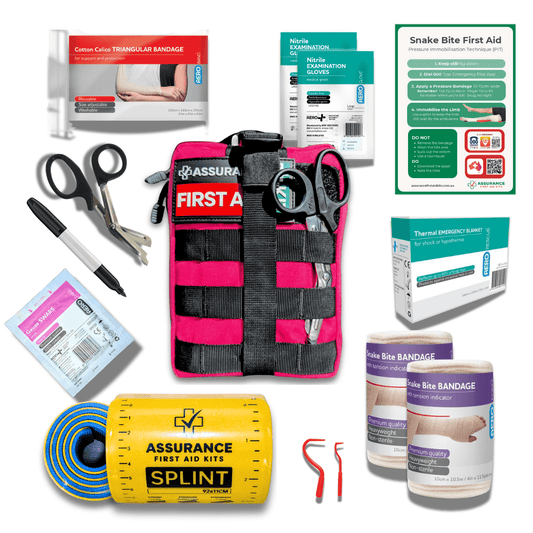
| Assurance Snake Bite Kits | ✓ | ✓ Add comfort tools, All About Me card, medications | Outdoor, bushwalking, regional and farm families | Shop Now |
Frequently Asked Questions
What if my child refuses to stay still during bandaging?
Regulate before you treat. Headphones on, comfort object in hands, familiar face close, unfamiliar people moved back. Narrate every step before you do it. If partial stillness is all you can achieve, apply the bandage as well as the situation allows — a partially applied bandage is better than none while you continue to regulate and wait for emergency services. Do not physically restrain unless there is no other option, as restraint significantly increases distress and movement.
How do I know if the bandage is tight enough on a young child?
Apply the bandage as firmly as you would for a sprained ankle — firm enough that you cannot easily slide a finger underneath, but not so tight that fingertips or toenails turn white or blue. Check nail bed colour regularly. Leave fingers or toes uncovered specifically so you can monitor circulation. If nails are discolouring, loosen the bandage very slightly and recheck.
Can I use any bandage or do I need a specific one?
An elasticised bandage 10–15 cm wide is preferred. Crepe bandages can be used but are less ideal. In an emergency, torn clothing, stockings, or any flexible material can be used. Dedicated pressure immobilisation bandages with built-in tension indicators — which change shape when the correct compression is reached — are available in Australia and are significantly more reliable for achieving correct pressure, particularly for those who have not practised the technique recently. These are worth having in your kit.
Should I tell the ambulance crew my child is neurodiverse?
Yes — immediately and clearly. Tell the 000 operator when you call. Tell the paramedics as soon as they arrive. Share which regulation tools are working and hand over your child's All About Me card if you have one. This allows emergency professionals to adjust their approach and reduces the risk of additional distress during handover and transport.
What if I am not sure whether it was a snake bite?
In Australia, treat any suspected snake bite as a real snake bite until confirmed otherwise. If your child was in long grass, near a wood pile, or in any snake habitat and is now showing signs of distress, has marks on their skin, or you heard a hiss or rustle — call 000 and apply pressure immobilisation. The cost of applying the technique unnecessarily is minimal. The cost of not applying it when it was needed is not.
Be Ready Before It Happens
A pressure immobilisation bandage applied correctly under calm practice conditions takes about two minutes. Applied for the first time under panic, on a distressed neurodiverse child, in snake territory — it is one of the hardest things you will do. Preparation is the difference.
Samantha suggests one of the following approaches — choose what suits your audience best:
✅ Option A — Direct Product
The Assurance Family First Aid Kit includes a pressure bandage and a personal medication space you can customise for your child — add regulation tools, your All About Me card, and specific medications alongside your standard supplies. Packed in Dubbo for Australian families.
Shop the Family Kit →🔍 Option B — Kit Finder
Not sure which Assurance kit suits your family and environment? Answer three quick questions and we'll match you with the right one — built in Australia, ready for real life.
Find My Kit →⚡ Option C — Urgency
Your child does not need to be easy to treat. They need you to be prepared to treat them. The right kit, the right technique, and one practice session at home could make all the difference.
Shop the Family Kit → Find My Kit →References
- Australian and New Zealand Committee on Resuscitation (ANZCOR) — Guideline 9.4.1: First Aid Management of Australian Snake Bite — anzcor.org
- Australian and New Zealand Committee on Resuscitation (ANZCOR) — Guideline 9.4.8: Envenomation — Pressure Immobilisation Technique — anzcor.org
- Australian Venom Research Unit, University of Melbourne — Pressure Immobilisation First Aid — biomedicalsciences.unimelb.edu.au/avru
- Better Health Channel (Victoria) — Snake Bite First Aid — betterhealth.vic.gov.au
- Sydney Children's Hospitals Network — Snake Bite in Children — schn.health.nsw.gov.au
- SafeWork Australia — First Aid in the Workplace — safeworkaustralia.gov.au