
Reviewed: 10 April 2026
🏠 A Kit Built for Real Australian Families
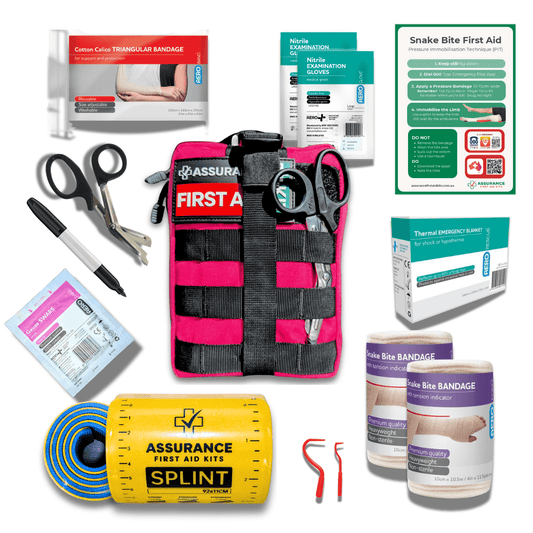
The Assurance Family First Aid Kit includes a personal medication space you can customise for your child's specific needs — including comfort tools, communication cards, and medications. Packed locally in Dubbo.
See the Family Kit → Find My Kit →🔴 Always Call 000 in a Medical Emergency
This guide covers interim first aid approaches for neurodiverse children. In any serious medical emergency, call 000 immediately. The techniques in this post are designed to support treatment — not replace professional emergency care.

Standard first aid advice was not written with neurodiverse children in mind. The assumption built into most guidelines is that a child in pain will hold still, follow instructions, and tolerate being touched by an unfamiliar adult under stress. For many autistic children, children with ADHD, sensory processing differences, or other neurodivergent profiles, that assumption does not hold — and it can turn an already difficult situation into a crisis.
If you are a parent or carer of a neurodiverse child, you have probably already thought about this. What happens if there is a snake bite at the park? A burn in the kitchen? A fall at a family event where the only first aider is a stranger? How do you get your child through treatment when their nervous system is already overwhelmed, when they cannot communicate what hurts, or when touch itself is the problem?
This guide covers what actually works — from someone who has worked clinically with autistic and non-verbal patients, trained first aiders across Australia for 19 years, and raised neurodiverse children. It is practical, specific, and built for real Australian families.

What Australians Need to Know About First Aid and Neurodiversity
Australia is home to approximately 200,000 autistic people, with many more Australians living with ADHD, sensory processing differences, and other neurodivergent profiles. The Australian Government's National Autism Strategy 2025–2031 explicitly recognises the need for services and systems that are accessible and sensory-friendly — acknowledging that standard approaches frequently do not meet the needs of autistic Australians and their families.
In a first aid context, this gap is significant. Most first aid training does not include neurodiversity-specific content. Most first aid kits do not include the distraction and regulation tools that can make the difference between a child cooperating with treatment and a child in complete shutdown. And most first aiders — even well-meaning ones — will instinctively use approaches that escalate rather than de-escalate a neurodiverse child in distress.
📍 Why This Matters in Regional Australia
For families in regional and rural NSW — Dubbo, Broken Hill, Orange, Tamworth, and beyond — the distance to specialist support makes this knowledge even more critical. If an emergency happens an hour from a hospital, the quality of interim care in those first minutes is everything. For neurodiverse children, that interim care looks different — and parents need to know what it looks like before it happens.
The good news is that the adaptations required are not complicated. They are largely about sequencing — doing things in the right order — and about preparation. The parents who navigate these situations most effectively are not the ones who improvise under pressure. They are the ones who have thought it through in advance and briefed the people around their child.
The Most Important Principle: Sensory Regulation First
This is the principle that changes everything, and it is the one most likely to feel counterintuitive in a panic.
When a neurodiverse child is in pain, frightened, or overwhelmed, their nervous system is already under extreme load. Adding more sensory input — unfamiliar touch, loud reassurances, bright lights, a crowd of concerned adults — does not help. It compounds the overload and makes cooperation with treatment significantly harder or impossible.
The correct sequence is not treat first, then calm. It is regulate first, then treat. Reducing the sensory environment before attempting any physical intervention gives you a child who is calm enough to be helped. Skipping this step gives you a child in full shutdown who cannot be helped at all.
✅ Regulate Before You Treat — What This Looks Like
- Headphones on first — if your child uses noise-cancelling headphones, put them on before any treatment begins. Reducing auditory input is one of the fastest ways to lower the overall sensory load.
- Device or comfort object in their hands — give them something familiar to hold before you touch them. This is not a reward for distress. It is a regulation tool that keeps their nervous system occupied so you can do your job.
- Remove unfamiliar people from their immediate space — ask bystanders to step back. Strangers escalate. Familiar faces calm.
- Get down to their level — crouch or sit. Looming is threatening. Eye level is safe.
- Dim or block light if possible — shade from the sun, move away from fluorescent lighting, use a hat or cloth if needed.
Voice Technique: How You Speak Matters as Much as What You Say
The instinct when a child is distressed is to speak louder, more urgently, and with more reassurance. For many neurodiverse children, this backfires. Loud reassurance reads as alarm. Urgency reads as danger. Volume compounds the auditory overload that is already part of the problem.
What works instead is low, slow, and predictable. Narrate exactly what you are doing before you do it. Not "it's okay, it's okay" — but "I am going to put my hand on your arm now." Predictability is regulating for autistic children. Surprises — even well-intentioned ones — are not.
💬 Voice Technique — Practical Tips
- Speak slowly and quietly — not loudly and urgently
- Narrate each step before you do it: "I am going to touch your leg now." "I am putting a bandage on." "This might feel cold."
- Use short, clear sentences — not long explanations under stress
- Avoid open-ended questions — offer binary choices instead: "Do you want to sit or lie down?"
- If the child is non-verbal or has limited communication, narrate anyway — it still provides predictability and reduces the shock of unexpected touch
Distraction Tools That Actually Work
Distraction during first aid treatment is not just acceptable — it is a legitimate clinical tool. Giving a child's nervous system something else to focus on during a painful or frightening procedure reduces their perception of pain, reduces the stress response, and dramatically improves cooperation.
The tools that work best are the ones your child already uses to regulate. This is not the moment to introduce something new. It is the moment to deploy what already works.
| Tool | How It Helps | Notes for First Aid Use |
|---|---|---|
| Noise-cancelling headphones | Reduces auditory overload — one of the most common sensory triggers | Put on before treatment begins, not during |
| Weighted toy or blanket | Proprioceptive input calms the nervous system and reduces fight-or-flight response | In hands or across lap during treatment |
| Fidget spinner or sensory toy | Gives hands something to do — reduces the urge to push away or pull at bandaging | Keep in kit bag or everyday carry |
| Bubbles | Visual focus, requires controlled breathing — naturally regulating | Highly effective across a wide age range and many neurodivergent profiles |
| Tablet or phone with familiar content | Strong focus anchor — absorbs attention during procedures | Headphones essential if using in a noisy environment |
| Comfort object from home | Familiar sensory anchor — reduces the dysregulating effect of an unfamiliar environment | Travels with the child — always |
See our full guide on what to pack when you leave home with a neurodiverse child.
First Aid Steps for Neurodiverse Children — Adapted from ANZCOR Guidelines
The following sequence applies the standard ANZCOR approach to first aid within a neurodiverse-adapted framework. The medical steps remain the same — the order of preparation steps is what changes.
- Call 000 if the situation is serious. Do this first, while someone else begins the regulation steps. Do not delay the call — but do begin regulation simultaneously if there are two adults present.
- Reduce the sensory environment. Ask bystanders to step back. Lower your voice. Move away from noise and bright light if possible. Get to the child's eye level.
- Deploy regulation tools. Headphones on. Comfort object or fidget toy in their hands. Familiar face close. Unfamiliar people at a distance.
- Narrate before you touch. Tell the child exactly what you are about to do in short, clear language. Wait a beat. Then proceed.
- Apply first aid treatment using standard ANZCOR technique for the specific injury or illness — wound care, pressure immobilisation, burn cooling, or as appropriate.
- Maintain narration throughout. Keep describing each step as you do it. If the child needs a break, pause briefly if it is safe to do so, then continue.
- Monitor for shutdown. A child who has gone very quiet and still may have shifted from distress into shutdown — which can look like compliance but is a different state. Continue to narrate and check in.
- Brief the ambulance crew. When emergency services arrive, tell them immediately that the child is neurodiverse. Share what regulation tools are working. Hand over the child's All About Me card if you have one.
⚠️ Meltdown vs Shutdown — Know the Difference
A meltdown is visible and loud — distress expressed outward through crying, screaming, or physical resistance. A shutdown is the opposite — the child becomes very quiet, unresponsive, and appears to comply. Both are signs of nervous system overwhelm. A child in shutdown is not fine — they have simply run out of capacity to respond. Continue regulation support and maintain calm, predictable narration in both states.
Briefing Other Adults — Before an Emergency Happens
The most effective preparation you can do is not about what happens during an emergency. It is about what you do before one.
Every adult who may be in an emergency situation with your child — grandparents, teachers, sports coaches, babysitters, family friends — needs to know three things: what regulation tools your child uses, where those tools are kept, and to hand them over immediately without asking questions first.
This briefing does not need to be long. It needs to be specific. "If something happens to Zara and she is upset, put these headphones on her first. Then give her this weighted toy. Don't touch her until she has both. Then call me."
✅ The All About Me Card — Your Most Important Preparation Tool
An All About Me card is a single-page communication document that tells any first responder or carer exactly what they need to know about your child in an emergency — their communication style, sensory triggers, regulation tools, medications, allergies, and GP details. It goes in the first aid kit. It goes in the school bag. It goes with every adult who cares for your child.
Read our full guide on how to create an All About Me card for your neurodiverse child — and download your free printable template here.
What to Include in Your First Aid Kit for a Neurodiverse Child
| Item | Purpose in a First Aid Context | Notes |
|---|---|---|
| Standard first aid supplies | Wound care, bandaging, burn treatment | As per ANZCOR guidelines |
| Noise-cancelling headphones | Reduce auditory overload before and during treatment | Keep in everyday bag — not just the kit |
| Bubbles | Distraction and breathing regulation during treatment | Small bottle — fits in any kit |
| Fidget toy or weighted item | Proprioceptive regulation — gives hands something to do | Whatever your child already uses |
| All About Me card | Communicates your child's needs to any first responder | Laminated — inside the kit and in school bag |
| Personal medication space | Child's specific medications, allergy info, GP details | The Assurance Family Kit includes this space |
| Red face washer | Nosebleeds — hides blood to reduce visual panic | White cloths show blood and alarm children |
| Honey sachet | ANZCOR button battery protocol — over 12 months only | Also useful as a comfort food for some children |
| Kit | Personal Medication / Customisation Space | Best For | Shop |
|---|---|---|---|
| Assurance Family First Aid Kit | ✓ Included — customise for your child's specific needs | Families with neurodiverse children | Shop Now |
| Assurance Snake Bite Kits | ✓ Pressure bandages included | Outdoor, bushwalking, regional and farm families | Shop Now |
Frequently Asked Questions
What if my child won't let anyone touch them during a first aid emergency?
Start with regulation, not treatment. Headphones on, comfort object in their hands, familiar faces close, unfamiliar people at a distance. Lower your voice, get to their eye level, and narrate every step before you do it. If touch is still not possible, keep the child as still and calm as possible and focus on getting professional help on the way. A child in shutdown or active resistance may require two adults — one to regulate and one to treat.
Should I tell emergency services that my child is neurodiverse?
Yes — immediately and clearly. Tell the 000 operator when you call. Tell the paramedics as soon as they arrive. Share what regulation tools are working and hand over your child's All About Me card if you have one. This information helps emergency professionals adjust their approach and reduces the risk of the child's distress being misread or mismanaged.
How is a meltdown different from a pain response?
This is one of the hardest things to distinguish in the field, and it matters. A pain response is typically linked to a specific injury site — the child may guard or point to the area, or show physical signs like swelling or bruising. A meltdown is a full nervous system overwhelm response that may look similar but is driven by sensory and emotional overload rather than localised pain. When in doubt, treat for both — regulate first, then assess the injury. Never assume visible distress is "just a meltdown" without checking for physical injury.
What if my child is non-verbal and cannot tell me where it hurts?
Start with a systematic visual assessment — check for visible injury, swelling, redness, or bleeding from head to toe. Look for protective posturing — a child guarding a limb or area. Watch for facial expressions of pain. Use binary yes/no questions if your child has any communication at all: "Does this hurt? Yes or no?" If your child uses an AAC device or communication board, make sure it is accessible. An All About Me card that lists your child's communication style is invaluable for any first responder who does not know your child.
How do I prepare other carers to help my neurodiverse child in an emergency?
Keep it specific and short. Tell them which regulation tools your child uses, where those tools are kept, and that the tools go on or in the child's hands before any treatment begins. Give them a laminated All About Me card that covers your child's communication style, sensory triggers, calming tools, medications, and your contact details. Practice the approach with your child in low-stakes situations so both the child and the carer are familiar with it before an emergency occurs.
Preparation Is the Best First Aid You Can Do
For neurodiverse children, first aid is not just about what is in the kit. It is about what is in the plan. The families who navigate these situations most effectively are the ones who have thought it through, briefed the right people, and made sure the right tools are always within reach.
Samantha suggests one of the following approaches — choose what suits your audience best:
✅ Option A — Direct Product
The Assurance Family First Aid Kit includes a personal medication space you can customise for your child — add their regulation tools, All About Me card, specific medications, and honey sachets alongside your standard supplies. Packed in Dubbo for Australian families.
Shop the Family Kit →🔍 Option B — Kit Finder
Not sure which Assurance kit suits your family's needs? Answer three quick questions and we'll match you with the right one — built in Australia, ready for real life.
Find My Kit →⚡ Option C — Urgency
Standard first aid kits were not built for neurodiverse children. Yours can be. Add the right tools, brief the right people, and make sure everyone who cares for your child knows the plan before something happens.
Shop the Family Kit → Find My Kit →References
- Australian and New Zealand Committee on Resuscitation (ANZCOR) — First Aid Guidelines — anzcor.org
- Australian Government Department of Health — National Autism Strategy 2025–2031 — health.gov.au
- Autism CRC — National Guideline for Supporting the Learning, Participation, and Wellbeing of Autistic Children and Their Families in Australia (2023) — autismcrc.com.au
- Better Health Channel (Victoria) — Autism Spectrum Disorder — betterhealth.vic.gov.au
- Sydney Children's Hospitals Network — Sensory Processing and Autism — schn.health.nsw.gov.au
- SafeWork Australia — First Aid in the Workplace — safeworkaustralia.gov.au