
Reviewed: 29 June 2026
Every winter, the question comes up in my courses: do snakes hibernate in Australia? The short answer is no — and that distinction matters more than most people realise. Australian snakes brumate, not hibernate, and the difference explains why a warm winter afternoon can bring a brown snake out from under your garden shed in July, and why the first weeks of spring are the most dangerous time of year for a snake encounter. Here's what every Australian — parent, hiker, farmer, or pet owner — needs to understand before the season turns.

What Australians Need to Know About Brumation and Snake Season
Most Australians grow up assuming snakes disappear completely in winter — tucked away in deep sleep somewhere, completely out of the picture until September. That assumption is one of the things that gets people bitten. Understanding what snakes are actually doing in winter — and what happens when they wake up — is the foundation of staying safe through spring and summer. If you want to understand what snake venom does in the body and why the first aid works the way it does, that post is worth reading alongside this one.
In the cooler southern states, Australian snakes do slow right down between roughly May and August. But they are not in a deep, unresponsive sleep. They can wake on a warm day, move toward a heat source, and if disturbed — under a log, behind a water meter, beneath a pile of timber — they can still strike. Venom potency does not decrease during brumation. A brumating snake is just as venomous as one in full summer activity. For a full overview of what you need in place before the season starts, read our snake bite preparedness guide.

In Western NSW — around Dubbo and across the central west — eastern brown snakes are the most commonly encountered species. They brumate through winter in sheltered spots: rock crevices, deep soil cracks, under corrugated iron, inside machinery sheds. On a sunny July afternoon, they may emerge briefly to warm themselves. By late August, they are out and actively hunting.
Brumation vs Hibernation: What's the Actual Difference?
People use these words interchangeably. They shouldn't. The distinction comes down to biology — specifically, whether an animal can generate its own body heat.
Hibernation (warm-blooded animals — mammals)
True hibernation is a deep, sustained physiological shutdown. Heart rate crashes. Breathing slows to almost nothing. Body temperature drops dramatically but is regulated internally. The animal does not need to wake to drink water. It does not respond to disturbance in the same way an active animal does. Think of a mountain pygmy possum in the Kosciuszko alpine zone — curled up in a boulder field, body temperature dropping to as low as 5°C, metabolic rate just 2% of normal, burning a gram of fat over two weeks. That is true hibernation.

Brumation (cold-blooded animals — reptiles and amphibians)
Reptiles cannot generate their own body heat — they are ectotherms. Their body temperature is whatever the environment around them is. When it drops, their metabolism crashes and they become sluggish and inactive. But they are not in a deep sleep. They can and do rouse — to drink water, to bask on a warm day, to move to a better shelter site. This semi-dormant state is brumation. It is triggered by a combination of dropping temperatures and shortening daylight hours, which is why a warm winter day doesn't necessarily bring snakes out — photoperiod (day length) is also part of the switch.
Australian Animals: Who Brumation and Who Hibernates?
| Animal | Type | State | Notes |
|---|---|---|---|
| Eastern brown snake | Reptile | Brumation | May–Sept in southern states; most dangerous Australian snake by bite fatality |
| Red-bellied black snake | Reptile | Brumation | May emerge on warm winter days to bask |
| Tiger snake | Reptile | Brumation | Cold-tolerant; can be active on mild winter days |
| Carpet python | Reptile | Brumation | Commonly found in roof spaces and sheds; surprises homeowners in spring |
| Blue-tongue lizard | Reptile | Brumation | Up to 12 weeks; emerges late Sept/Oct — common backyard species |
| Bearded dragon | Reptile | Brumation | Well known to pet owners; also wild across mainland Australia |
| Eastern long-necked turtle | Reptile | Brumation | Brumation in freshwater environments; moves overland in summer |
| Mountain pygmy possum | Mammal | True hibernation | Alpine Vic & Kosciuszko NP; body temp drops to 5°C; can hibernate up to a year |
| Eastern pygmy possum | Mammal | True hibernation | East coast from Qld to SA; metabolic rate just 2% of normal |
| Short-beaked echidna | Mammal | Hibernation (Tas) / torpor (mainland) | Body temp aligns with soil; hibernates Feb–May in Tasmania |
| Fat-tailed dunnart | Mammal | Daily torpor | Up to 20 hours/day in Outback NSW; reduces energy needs by 80% |
| Sugar glider | Mammal | Daily torpor | Cold nights only; not sustained hibernation |
| Insectivorous bats | Mammal | True hibernation | Cave hibernators in cooler months across southern Australia |
Why Spring Is Your Highest-Risk Season
Here's what nobody tells you: snakes don't just wake up in spring and go about their business calmly. They emerge from brumation hungry, hormonally primed, and on the move. That combination of factors is exactly why snake bite presentations to Australian hospitals peak in spring and summer — not mid-winter.
There are five reasons spring carries the highest risk:
- They haven't eaten in months. An eastern brown emerging in September has been burning stored fat since April. It is actively hunting. That means it is covering ground it wouldn't normally cover — into backyards, through paddocks, across hiking trails.
- Males are competing for females. Eastern brown snakes begin mating from early October. Males travel considerable distances searching for females and engaging in ritualistic combat — two males wrestling with entwined bodies, sometimes for hours. This movement puts snakes in unexpected places at unexpected times.
- Snakes are more reactive post-brumation. They're still warming up, slower to retreat, and quicker to feel cornered. Most Australian snake bites happen when people try to move, catch, or kill a snake — and the risk of that accidental encounter is highest when snakes are newly emerged and exploring unfamiliar territory.
- You're outside more too. Spring gardening, trail running, school sports, camping. The overlap between human activity and snake movement is at its annual peak from September through November.
- Juveniles are fully venomous. The prior season's hatchlings — eastern brown eggs laid in late spring/early summer, hatching around 11 weeks later — are now active juvenile snakes. They are small, easily mistaken for non-venomous species, and just as venomous as adults.
- Gardeners: Disturbing snakes sheltering under rocks, logs, compost, or garden debris
- Parents/children: Kids playing in long grass, near sheds, or around water in early spring
- Hikers: October–January is peak snake bite season on Australian trails; lower legs are most commonly bitten — long pants and boots make a real difference. See also our hiking first aid kit guide for what to carry on the trail
- Farmers: Agricultural land is prime eastern brown habitat — sheds, hay bales, machinery, rodent populations
- Pet owners: Dogs bitten on the face or nose, often in backyards — higher venom dose relative to body weight
NSW Health confirms snake bite presentations increase in spring ahead of a peak in late December and January. If you're in Western NSW — and I train people across this region every year — the eastern brown is your primary concern. It thrives in agricultural land, suburban blocks, and anywhere there are rodents. Out here, help can be an hour away. We live too far away from that book. Knowing the first aid before the season starts isn't optional — it's the whole game. If you're heading into remote country, read our survival first aid guide for what to do when help is hours away.
Read more about how Australian snake breeding behaviour affects your risk and why spring sightings spike.
First Aid Steps — As per ANZCOR Guidelines
If you or someone with you is bitten by a snake — or you suspect a bite — these are the steps. This applies year-round, but your risk of needing them is highest in the months immediately following brumation.
-
1Call 000 immediately. Don't wait for symptoms. Envenomation can be delayed — you may feel fine for 30–60 minutes and then deteriorate rapidly.
-
2Keep the person still. Your instinct will be to run for help. Don't. Movement moves venom through the lymphatic system faster. Lie them down and keep them as still as possible.
-
3Apply a pressure immobilisation bandage (PIB). Start at the bite site, bandage firmly up the entire limb — tip to pit for an arm, tip to hip for a leg. Firm enough that you can just slide a finger under it. Then splint the limb to prevent movement.
-
4Do not remove the bandage until the person is in hospital with antivenom available. Removing it early releases a concentrated bolus of venom into the bloodstream.
-
5Do not wash the bite site. Traces of venom on the skin allow hospital staff to identify the species using a venom detection kit, so the correct antivenom is given.
-
6Do not cut, suck, or tourniquet. These are all dangerous myths. A tourniquet cuts off circulation entirely — it is not the same as pressure immobilisation. Do not attempt these.
-
7Monitor and reassure. Keep the person calm, warm, and lying down. Note the time of the bite. If they lose consciousness and stop breathing, begin CPR.
Watch: What Is Brumation?
Kara breaks down what brumation actually means for Australian wildlife — and what it means for your safety as temperatures rise in spring. Worth two minutes of your time before the season turns.
Be Ready Before They Wake Up: The Snake Bite Max Kit
Most snake bite kits stop at immobilisation bandages. That's a start — but a snake bite, spider bite, or sting from a marine creature doesn't just deliver venom. It punctures skin, introduces bacteria, and creates a wound that needs proper management, especially when you're hours from a hospital.
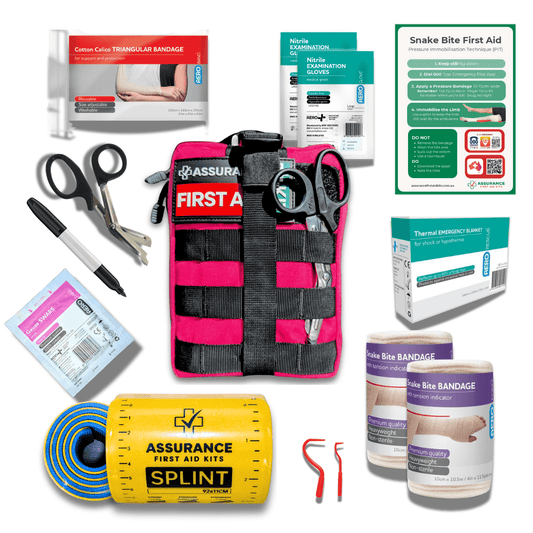
The Assurance Snake Bite Max Kit is the only kit on the Australian market built for the full range of what this country throws at you. It covers snakes, funnel-web spiders, blue-ringed octopus, cone shells, ticks, fire ants, bull ants, scorpions, and bee stings. It treats the wound — with hospital-grade dressings, cleansing wipes, forceps, and a surgical razor for clearing fur or hair before bandaging. And it works on your pets as well as your family.
Now available in the new season black colourway or the original orange. Both are identical inside.
| Kit | Covers | Best For | |
|---|---|---|---|
| Snake Bite Max — Orange | Snakes, spiders, marine stings (jellyfish, Irukandji), ticks, insects + wound care | Farm families, remote workers, pet owners, hikers | Shop Now |
| Snake Bite Max — Black | Identical contents to orange | Worksites, park rangers, anyone who prefers a low-profile colourway | Shop Now |
| Full Snake Bite Kit Range | Regulator, Plus, Max — compare side by side | Not sure which kit is right? Start here | Compare Kits |
See the kit in action — including why the surgical razor matters for pets:
Frequently Asked Questions
Do Australian snakes actually hibernate?
No. Australian snakes brumate — a semi-dormant state where their metabolism slows dramatically but they can still rouse on warm days. True hibernation, the deep sustained sleep, is for warm-blooded mammals. Snakes are cold-blooded and cannot maintain body heat independently, so their dormancy is more flexible and temperature-dependent than mammalian hibernation.
When do snakes come out of brumation in Australia?
In southern and inland Australia — including Western NSW — most snakes begin emerging from brumation from late August, with activity increasing significantly through September and October. In Queensland and tropical northern regions, snakes may remain partially active year-round. With climate change shortening brumation windows, emergence dates are shifting earlier.
Is a brumating snake less dangerous?
A brumating snake is slower to react and less likely to strike unprovoked — but its venom is just as potent as at any other time of year. Venom composition and toxicity do not change during brumation. If a brumating snake is disturbed — particularly if you put a hand or foot near it without looking — it can and will bite defensively.
Which Australian mammals actually hibernate?
True hibernators in Australia include the mountain pygmy possum and eastern pygmy possum (both in alpine southeast Australia), the short-beaked echidna (particularly in Tasmania), and several insectivorous bat species. Many other native mammals — dunnarts, sugar gliders, antechinus — use torpor, a shorter-duration energy-saving state, rather than full seasonal hibernation.
What should I do if I find a snake in my garden in winter?
Leave it alone and keep children and pets inside. Do not attempt to move, kill, or handle it — this is how the majority of Australian snake bites occur. Contact a licensed snake catcher in your area. Snakes are protected under wildlife legislation in all Australian states. If a snake is inside your home, close internal doors to contain it to one room and call a snake catcher immediately.
Don't Wait for Snake Season to Start
Brumation ends before most people remember to prepare. The Snake Bite Max kit is ready to go — packed by hand in Dubbo, shipped fast, and built for the full range of Australian envenomation including snakes, spiders, ticks, marine creatures, and pets.
Compare All Snake Bite Kits
Not Sure Which Kit? Find Mine
Still not sure if you need a snake bite kit? Read: Do I really need a snake bite kit in Australia?
References
- CSIRO — Warm winters are waking snakes early. Here's what that means for them and us — csiro.au
- Australian Geographic — Warmer winters are waking snakes from their slumber sooner — australiangeographic.com.au
- NSW Health — Be ready for snakes and spiders — health.nsw.gov.au
- Australian Resuscitation Council — ANZCOR Guideline 9.4.1 — Envenomation: Snake Bite — resus.org.au
- Australian Venom Research Unit — Snake Bite First Aid — biomedicalsciences.unimelb.edu.au/avru
- Better Health Channel — Snakebite — betterhealth.vic.gov.au
- Australian Academy of Science — Not just sleep: all about hibernation — science.org.au
- SA Department for Environment and Water — Snakes and adders: play it safe this summer — environment.sa.gov.au