
Updated March 2026| Written by Samantha Kerr, First Aid Trainer, Outback NSW
Quick Answer
Most snake bites in Australia occur on the lower limbs — particularly the foot, ankle and lower leg. Around 80–90% of reported bites involve the arms or legs. These areas are most at risk because snakes strike defensively when stepped on, approached, or disturbed at ground level.
Understanding where bites happen helps you reduce risk — and respond properly if one occurs.

Why This Matters
Snake bites in Australia don’t always feel dramatic. Some are painless at first. Yet the location of the bite can influence how quickly venom spreads and how urgent immobilisation must be.
As a First Aid Trainer in Outback NSW for 18 years, I’ve seen that panic often comes from uncertainty. Preparation is about clarity — not fear.

Common Body Sites for Snake Bites in Australia
- Feet & ankles: Most common when walking barefoot, wearing thongs, or stepping into grass or leaf litter.
- Lower legs: Often bitten when brushing past hidden snakes in scrub, paddocks, or bushland.
- Hands & arms: Occur when reaching into sheds, woodpiles, compost bins, or garden beds.
Approximately 80–90% of snake bites in Australia occur on the limbs.
Snake Bite Locations and Scenarios
| Body Area | Common Scenario | Relative Frequency |
|---|---|---|
| Foot / Ankle | Stepping near or on a snake in grass or bushland | Most common |
| Lower Leg | Walking through long vegetation | Very common |
| Hand | Moving timber, gardening, reaching into sheds | Second most common |
| Forearm | Lifting debris or clearing brush | Less common |
| Torso / Chest | Rare outdoor contact | Uncommon but higher risk |
Why Limbs Are Most at Risk
Snakes strike defensively when startled. Limbs are exposed for several reasons:
- Limited visibility when stepping or reaching
- Proximity to ground-level habitats
- Bare skin or lack of protective clothing
- Joint movement (ankles, wrists, knees) that increases lymphatic flow
Movement accelerates venom spread. Immobilisation is critical.
🎥 Video: One of the Most Common Questions I Get as a First Aid Trainer
📩 Stay in the Snake Education Loop
We share practical snake safety education, seasonal activity updates, first aid refreshers, and training videos — designed for Australian families, rural properties and outdoor travellers.
Preparedness is ongoing. Stay informed, not alarmed.
Where Snakes Live in Australia
Snakes seek shelter in:
- Backyards — timber piles, compost heaps, long grass
- Sheds & garages — cluttered storage areas
- Bushland & paddocks — leaf litter, rocky outcrops, creeks
- Rural properties — hay bales, feed sheds, water tanks
Tip: Snakes follow food. Rodents near sheds or pet food attract them.

🚑 Snake Bite Quick Guide (ANZCOR)
- Call 000 immediately.
- Keep the person completely still.
- Do NOT wash, cut, or suck the bite. Never use a tourniquet.
- Apply a pressure immobilisation bandage starting at the bite and wrap the entire limb firmly.
- Immobilise the limb with a splint.
- Monitor breathing. Be prepared for CPR.
- Do not remove the bandage until medical professionals advise.
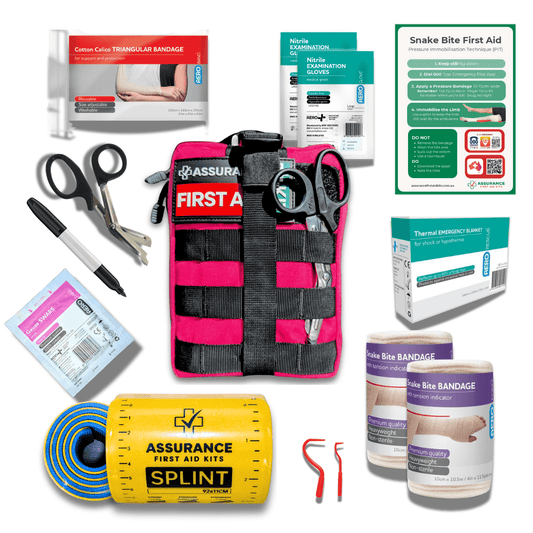
Because most bites occur on limbs, a bandage long enough to wrap from fingers or toes to the top of the limb is essential. Not all standard first aid kits include suitable venom compression bandages.
Choosing the Right Snake Bite Kit
Different environments require different levels of preparedness.
| Kit | Best For | Pressure Bandage Included | Extra Bite & Sting Support | Ideal Location |
|---|---|---|---|---|
| Snake Bite Kit | Bushwalkers, regional homes | Yes | Basic | Daypack, shed |
| Snake Bite Plus Kit | Families, vehicle storage | Yes | Cleaning & support items | Car, home |
| Snake Bite Max Kit | High-risk areas, campers | Yes | Multi bite & sting coverage | 4WD, caravan |
| Family First Aid Kit | Everyday injuries + venom response | Yes | Burn care & wound management | Kitchen, laundry |
| 4WD Outdoor Kit | Remote travel & off-grid trips | Yes | Comprehensive trauma coverage | Vehicle, camper |
All Assurance kits are packed in Australia with clinical-grade supplies and organised clearly for fast response.
All Assurance kits are packed in Australia with clinical-grade supplies and organised clearly for fast response.
Reducing Your Risk
- Wear enclosed boots and long pants in bush or rural areas.
- Use gloves when gardening or handling timber.
- Keep grass short and sheds sealed.
- Carry a snake bite kit when travelling regionally.
Frequently Asked Questions
Do all Australian snakes inject venom?
No. Dry bites occur, but always treat every bite as venomous.
Are snake bites always painful?
Not necessarily. Some feel like a scratch or minor sting.
Can you survive a snake bite in Australia?
Yes. With immediate first aid and hospital treatment, survival rates are high.
Where do most bites occur — home or bush?
Many occur around the home, particularly in sheds and gardens.
About the Author
Samantha Kerr has been a First Aid Trainer in Outback NSW since 2008. With 18 years in the industry, she has trained thousands of Australians in snake bite prevention and response. She provides practical training resources to help people respond calmly and correctly.
References
- ABC News — Spike in deadly snake bites, Mount Isa (2024)
- Courier Mail — Sunshine Coast case (2024)
- University of Melbourne — Fatal snake bites (2017)
- Healthdirect — Snake bite symptoms
- ANZCOR — Australian Snake Bite First Aid Guidelines