
Reviewed: 27 April 2026
A child's first anaphylactic reaction may happen at school, at daycare, or on a sporting field — not at home with their parents nearby. That's why the obligation on Australian educators and club officials extends well beyond keeping an EpiPen in the office. It requires a system — one that works even when the child's regular teacher is away, when the first aid officer is on the other side of the oval, or when the reaction happens during an excursion.
This guide covers what Australian schools, early childhood services, and sporting clubs are required to have in place, what a complete anaphylaxis system looks like, and specific considerations for neurodiverse students who may present or communicate differently during a reaction.
Find the right first aid kit for your school, daycare or sporting club.
School & Sports Kits Find My KitWhat Australian Educators and Clubs Need to Know
Anaphylaxis management in Australian schools and early childhood services is governed by a combination of state education department policies, the national ASCIA Anaphylaxis Guidelines for Schools, and general duty of care obligations. Sporting clubs operate under the WHS framework and general duty of care — without the same prescriptive requirements as schools, but with the same legal obligation to manage foreseeable risks.
The core principle across all settings is the same: if anaphylaxis is a foreseeable risk — because a child has a known allergy, because food is served, because outdoor environments bring insect sting risk — appropriate management must be in place before an incident occurs.
What Each Setting Must Have in Place
Anaphylaxis management policy · Individual ASCIA Action Plans for at-risk students · Adrenaline autoinjectors for known students · General-use autoinjector (state-dependent) · Annual staff training · Communication plan for excursions and events
Anaphylaxis management policy required under National Quality Framework · Individual medical management plans for at-risk children · Autoinjectors stored accessibly — not locked away · Staff trained in recognition and response · Risk minimisation strategies for food service
No prescriptive mandate but duty of care applies · First aid kit at every training and event · Consider general-use autoinjector if food is served or insect sting risk is present · At least one trained first aid officer per session · Parental notification system for at-risk players
Individual Action Plans must travel with the child · Autoinjector must be accessible — not in a locked bag on the bus · At least one trained adult per group · Communication plan with emergency services for remote locations · Risk assessment for allergen exposure at the destination
The Components of a Complete School Anaphylaxis System
A policy document without practical implementation does not protect students. A complete system includes the following elements working together:
- Current, signed ASCIA Action Plan for every at-risk student — reviewed and updated annually or when medication changes
- Adrenaline autoinjector stored accessibly — not locked in the office, not in a bag that requires a key
- Photo of the student attached to the Action Plan so any staff member can identify the correct child
- All staff trained in recognition of anaphylaxis and correct use of the autoinjector — not just the school nurse or first aid officer
- General-use autoinjector for undiagnosed first reactions — check your state education department for requirements
- Risk minimisation strategies in place — food allergies communicated to canteen, excursion risk assessments conducted
- Communication protocol — who calls 000, who contacts the parents, who stays with the student
- Annual review of all Action Plans and equipment expiry dates
Anaphylaxis Response Steps at School — As per ANZCOR Guidelines
- Recognise the signs. Any combination of breathing difficulty, circulation changes, or two-system involvement after possible allergen exposure should be treated as anaphylaxis — even if the child has never reacted before.
- Locate the ASCIA Action Plan. Retrieve the student's individual plan. Confirm the correct medication and dose. If no plan is available and anaphylaxis is suspected, use the school's general-use autoinjector.
- Lay the student flat. Do not allow them to stand or walk. If breathing is difficult, allow slight sitting up. Keep them as flat as possible.
- Administer the adrenaline autoinjector. Follow the technique as per the Action Plan and training. Note the time.
- Call 000 immediately. Even if the student appears to improve. All anaphylaxis requires emergency medical assessment. Notify the parents.
- Give a second dose after 5 minutes if no improvement. If a second autoinjector is available and symptoms are persisting, give a second dose.
- Stay with the student until the ambulance arrives. Do not leave them alone. Monitor breathing and response.
Neurodiverse students — including those with autism, ADHD, anxiety, or communication differences — present specific challenges in anaphylaxis management that require deliberate planning, not just general policy compliance.
Recognition challenges: A neurodiverse student may not be able to communicate that they are feeling unwell, or may communicate distress in ways that staff misread as a behavioural episode rather than a medical emergency. Staff should be briefed specifically on how an individual student presents when unwell — this information should come from parents at enrolment and be documented in the Action Plan.
Action Plan adaptations: The standard ASCIA Action Plan template may not capture the behavioural indicators that are most relevant for a neurodiverse child. Ask parents to provide supplementary information — what does this child do when they feel unwell? What are the signs that something is wrong beyond the standard symptom list?
Medication administration: A neurodiverse student may resist injection during an emergency. Discuss with parents and the prescribing allergist whether Neffy (nasal spray) is an appropriate alternative — particularly for students with significant needle aversion. If EpiPen is the prescribed device, brief the staff member most familiar with the child on the most effective approach for that individual.
During the event: Reduce sensory input where possible. Use the student's preferred communication methods. Involve a familiar adult where possible — not a stranger. Avoid restraint unless absolutely necessary, as this can significantly escalate distress and worsen the physiological response.
For broader guidance: First Aid for Neurodiverse Children — A Practical Guide → and What to Pack When You Leave Home with a Neurodiverse Child →
What to Keep in Your School or Club First Aid Kit
A school or sporting club first aid kit should be equipped to manage an anaphylactic reaction as part of its standard contents, alongside general first aid supplies.
- CPR barrier mask — in case the reaction progresses to respiratory arrest
- Disposable gloves — for safe administration of medication
- Clearly labelled location for individual student autoinjectors and Action Plans
- General-use autoinjector storage (where required by state policy)
- Comprehensive wound care, bandaging, and burn treatment for broader first aid needs
- Thermal blanket — for shock management while waiting for the ambulance
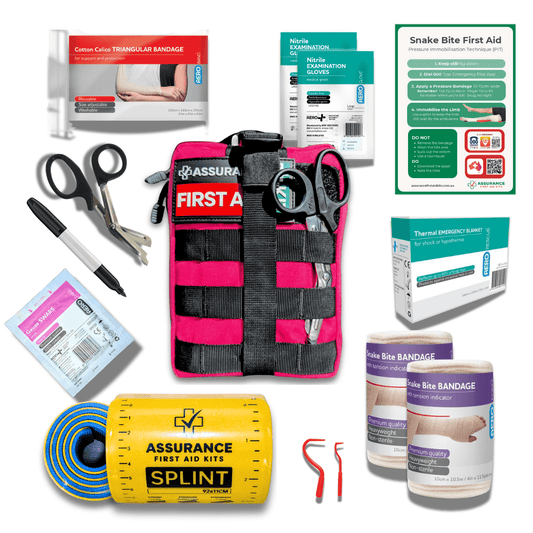
Assurance school and sports kits are organised for shared environments — clearly labelled compartments, hospital-grade supplies, and a structure that any adult can navigate under pressure. The Family First Aid Kit also includes a dedicated medication storage section for individual student autoinjectors and Action Plans.
School & Sports Kits → Family First Aid Kit →Frequently Asked Questions
Are Australian schools required to have an EpiPen?
What is the duty of care for sporting clubs around anaphylaxis?
What is a general-use adrenaline autoinjector?
How should an autoinjector be stored at school?
How do I manage a neurodiverse student's anaphylaxis risk at school?
Is Your School or Club Properly Equipped?
Kits organised for shared environments — hospital-grade supplies, clear layout, ready when it matters.
School & Sports Kits → Family Kits → Find My Kit →References
Australian Resuscitation Council — ANZCOR Anaphylaxis Guidelines (resus.org.au)
Sydney Children's Hospitals Network — Anaphylaxis in schools (schn.health.nsw.gov.au)
Royal Children's Hospital Melbourne — Anaphylaxis management in schools (rch.org.au)
Asthma Australia — Allergy and anaphylaxis in education settings (asthma.org.au)
Better Health Channel — Anaphylaxis (betterhealth.vic.gov.au)