
Reviewed: 29 June 2026
Water Beads Look Like Lollies to a Toddler. They've Put Aussie Kids in Surgery.
Your instinct says a non-toxic craft bead is harmless. It isn't. Once swallowed it swells in the gut, it barely shows on an X-ray, and the NSW Poisons Information Centre still takes calls about it every year. Here's what's actually going on — and what to do.
Find My Kit →Every time I bring water beads up in a class, the room changes. Someone always says it — "Oh my gosh, my kids have those." They had no idea the beads don't show up on an X-ray. No idea how big they swell once they're inside a child. People who'd happily had a tub of them on the coffee table go quiet, then go home and bin them.
So let me give you the same information that startles a room full of parents, because it might be the thing that changes your mind before something happens, not after.

Water beads — you'll also see them as Orbeez, gel beads, jelly beads, water pearls, fairy eggs or dragon eggs — are little balls of superabsorbent polymer. The same family of material that's in a nappy. Dry, they can be smaller than a grain of sand. Drop them in water and they swell to around 100 times their size, some up to 6 cm across. That swelling is the whole appeal. It's also the whole danger.
Here's the part most people miss: when the ACCC told suppliers to stop selling them as toys, the beads didn't disappear. The wording moved. They're still on sale all over Australia — now badged as "vase filler", "floral decoration" or "sensory product, not a toy". Same bead. Same bright colours. Same appeal to a toddler who can't read the label. The marketing grew a conscience; the product didn't change.
The Australian Competition and Consumer Commission (ACCC) has been warning about water beads since 2015, when three Australian children needed medical procedures to have swallowed beads removed. It has since overseen voluntary recalls of specific water bead products sold for children.
The ACCC's line is plain: once swallowed, just one bead can expand inside a child's body and cause a bowel obstruction, vomiting, severe discomfort and dehydration — and may need to be surgically removed. These beads have been linked to the deaths of children both here in Australia and overseas. There is still no mandatory safety standard for them in this country. They're legal. That doesn't make them safe in a house with little kids.
Now let me be straight with you about the Australian numbers, because someone will tell you "it's rare." Here's what we actually have. The NSW Poisons Information Centre logged 129 children swallowing these between 2004 and mid-2016 — and tellingly, 87% of those happened from 2013 on, as the craze took off. The Queensland Poisons Centre counted another 71 calls from 2018. Two states, roughly 200 kids, and that's only the cases where someone rang a poisons line.

The honest part: there is no current national tally. A senior NSW poisons specialist has said plainly that up-to-date data simply isn't collected here. So when the Australian figure looks small and old, that's not because it stopped happening — it's because nobody's counting. About one in five of those children ends up in hospital.
Overseas, where they do count, the scale is sobering — and it tells us something useful. US poison centres logged more than 20,000 ingestions in under-sixes between 2019 and 2024, a rise of over 6,500% to 2023. Then the rate fell about 24% the following year — right as major retailers pulled the product from shelves and tougher standards came in. Where regulators and shops actually acted, the injuries started dropping. Australia hasn't taken those steps. The beads are still here, still legal, still on the shelf as "decoration."
What Parents Actually Ask Me
Most of the worry about water beads comes down to four questions. Each one is a sensible instinct that happens to be wrong — so let me name it, then give you the real answer.
"The packet says non-toxic — so they're safe, right?" Non-toxic and safe are two different things. Nobody's saying the polymer poisons your child like a chemical would. The danger is mechanical — a bead that soaks up fluid and swells inside the bowel can block it, and a blocked bowel is a surgical emergency. "Non-toxic" is answering a question you weren't asking.
"They only swallowed one — surely one's fine?" One is enough. A single bead can swell in the small bowel and cause a complete blockage. Australian poisons specialists have flagged the bigger beads — the ones that reach golf-ball or larger — as the most dangerous of all. Don't count beads and feel reassured. If one's gone in, act on it.
"Won't it just show up on an X-ray?" No — and this is the one that stops people in their tracks. Water beads are radiolucent. They're not dense like bone or a coin, so they're close to invisible on a standard X-ray. A doctor can be looking at the film and not see the thing that's causing the problem. That's why you have to say it out loud: "I think they may have swallowed a water bead." That one sentence changes how the whole thing gets investigated — they'll reach for ultrasound or a CT instead. No one cares about your kid like you do, so advocate.
"We use them for sensory play with our autistic child — what do we use instead?" Fair question, and a common one — these get sold specifically as a sensory aid. The honest answer is they're a poor fit for any child who might mouth them, and that includes a lot of kids with developmental differences. There are safer options that do the same job. They're further down this page.
The Quiet Reason This Is Slipping Off the Radar
Here's something that's been on my mind. The warning labels and the recalls did some good — they pulled the worst products and they got the message out. But awareness has a strange side effect: when a danger goes quiet, people assume it got fixed. It didn't. The label changed. The bead is exactly as dangerous as it ever was.
And there's a whole new wave of parents who missed the original scare entirely. If you're a first-time mum in 2026, the big Orbeez craze and the warnings that chased it might have come and gone before you ever had a child to worry about. Nobody sat you down and told you, because to everyone who lived through it, it feels like old news. So a tub of pretty beads turns up as a gift, or a sensory kit, or a decoration on a shelf — and it looks completely benign, because no one ever told you otherwise.
That's the gap I'm trying to close. Not to frighten anyone — just to make sure the information reaches the people who never got it the first time around.

Picture the bead doing what it's designed to do — only inside a child instead of inside a vase. It keeps drawing in fluid from the gut and keeps growing, slowly, over hours. There's the catch: a small dry bead slips down easily and causes no drama at the time, then swells into a blockage well after everyone's stopped watching. Symptoms can take anywhere from six hours to five days to show. By then, no one's connecting "off colour today" with "played with the beads on Tuesday."
Here are the four ways they cause harm. Each one has a clear action — I'm not in the business of frightening you without telling you what to do about it.
😮 Choking — but slippery
A hydrated bead is soft and squishy, so it moulds to the shape of the airway instead of sitting there like a firm lump. That can make it harder to shift than a solid object. Back blows and chest thrusts are still exactly right — see the steps below — but don't expect it to pop straight out.
🫁 Swelling in the gut
The real headline risk. A swallowed bead keeps expanding in the bowel and can block it completely, which means surgery to remove it. The delay is the trap — your child can seem fine for most of a day first.
👂 Up the nose, in the ear
Toddlers post things into noses and ears — that's just toddlers. A bead in there draws moisture and swells against the eardrum or nasal lining, causing pain, infection and possible lasting damage. Don't go digging for it — that's a job for the ED with the right tools.
🔬 Hides on an X-ray
Because they barely show on standard imaging, the cause of a sick child can be missed for days — especially if no one saw the bead go in. Your job is to put the possibility on the table so the team images for it properly.
These come in packs of thousands, and dry they're nearly invisible — down the side of the couch, in the carpet, under the skirting. You can pack them all away, do a proper clean-up, and a single bead you never saw is still sitting in the rug weeks later when a crawling baby finds it. This is how a switched-on parent ends up with a swallowed bead they didn't know about. It's not carelessness. It's the product.
What to Watch For After a Possible Swallow
If you think a bead may have gone in — even if you're not sure, even if your child seems fine right now — keep an eye out for these, and don't sit on them:
- Vomiting
- Swollen or sore tummy
- Going off food or drink
- Constipation or no bowel motions
- Signs of dehydration
- Drooling or trouble swallowing
- Gagging or coughing
- Unusually flat or distressed
If you know or strongly suspect your child has swallowed a water bead, don't wait for symptoms to build. Get to the emergency department and tell the team exactly what happened. Take the packet or a spare bead with you — the size tells them how worried to be. On the way, call the Poisons Information Centre on 13 11 26 — they're there 24 hours a day, every day, and they'll tell you exactly what to do next.
Is the kit at home actually ready?
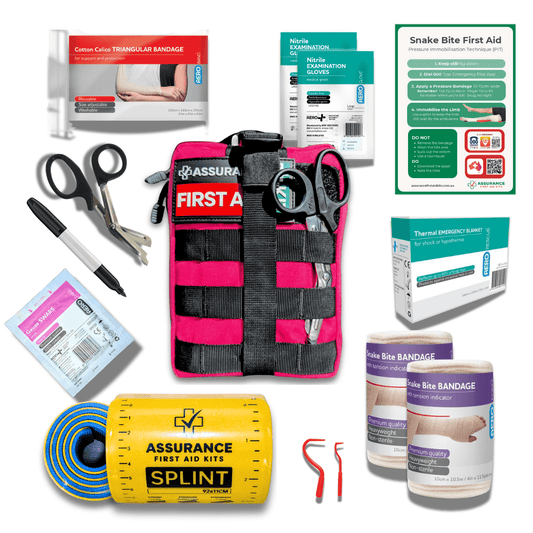
When something goes in a little mouth, you want gloves, a clear choking guide and the right gear in one place — not a scramble through the bathroom cupboard. Our Family First Aid Kit is built for real Australian households, not a tick-box.
Shop the Family First Aid Kit →If They're Choking — the ANZCOR Steps
If a bead — or anything else — is blocking your child's airway, you act straight away. This is the ANZCOR protocol for a choking baby or child. It's worth reading now, while it's calm, because you won't be reading anything mid-emergency. For more on this, I've got a full guide on what to do if your baby chokes, including prevention.
- Let them cough. A strong cough is the best tool they've got — better than anything you can do. Stay right there and watch.
- Don't leave them, don't whack their back "to help". If the cough is working, let it work. Be ready to step in the second it stops.
- Call 000 — or point at someone and tell them to call while you start. On your own? Use the Emergency+ app, it gives the operator your location.
- Baby face down along your forearm or lap, head lower than the bottom, jaw supported.
- Up to 5 firm back blows between the shoulder blades with the heel of your hand. Check after each one — you might clear it on the first.
- Not clear? Turn them face up, head still lower than the body.
- Up to 5 chest thrusts — two fingers for a baby, heel of the hand for an older child — on the breastbone, not the tummy. Check after each.
- Keep alternating 5 back blows, 5 chest thrusts until it clears, help arrives, or they go unconscious.
- If they go unconscious, start CPR and keep going until the ambulance is with you. When in doubt, pump them out — you can't make it worse.
A soft, wet bead moulds to the airway instead of staying put, so it can be more stubborn than a hard object. Don't let that rattle you — the protocol doesn't change. Firm back blows, firm chest thrusts, 000 early. Don't hold off calling for help while you keep trying; do both at once.
Not sure it's a 000 job? CubCare is worth knowing
If your child may have been near the beads but isn't showing anything urgent, and you want a proper paediatric opinion — especially after hours when your GP's shut — CubCare connects you with a children's doctor from home, seven days a week, Australia-wide, no referral. It's not a paid plug from me; I just rate it. Unlike a general health line staffed by generalists, this is specific to babies and kids, which is exactly what you want when it's your child.
But get the order right: if there's any real chance a bead's been swallowed, that's an emergency department or 000 call, not a telehealth booking. CubCare earns its place after the emergency's been ruled out, for the "is this normal now?" monitoring questions. For any ingestion worry, ring the Poisons Information Centre on 13 11 26 first. Their site is cubcare.com.au.
What You Can Actually Do — Today
- Little kids in the house? Get rid of them. Not "up high" — gone. The ACCC's floor is under-fives, but if you've got a child who still mouths things, or a child with developmental differences, or grandkids who visit, the simple, safe call is to have none in the home at all.
- Have the chat with the bigger kids — why the beads don't go anywhere near a mouth, a nose or an ear, and why they never hand them to a little brother, sister or cousin.
- Ask the daycare, preschool or school. If water beads are used in class, ask how they're supervised and whether the kids are the right age for it. You're allowed to ask. It's your child.
- Check the homes where your child gets minded — grandparents, family, paid carers. A decorative vase of beads on Nan's windowsill is the easiest thing in the world to miss.
- Binning them? Crush them first so they can't swell in landfill, and keep them out of drains and waterways — they're a problem for wildlife too.
- Be wary of the social media stunts. The "Orbeez challenge" — firing hydrated or frozen beads from gel blasters — causes eye injuries and welts. None of it is safety-tested.
- Spot something unsafe? Report it to Product Safety Australia at productsafety.gov.au or 1300 30 40 54.
One more thing worth your time: I talk about choking a lot in class because it's the hazard parents most underestimate and most want to fix once they've seen it done. There are free choking guides and room-by-room clean-up checklists on the site you can use to sweep your own place — or the places your kids get cared for. And if water beads have got you thinking, read my button battery safety checklist next — it's the same story of a tiny, ordinary-looking thing that does real damage when it's swallowed. Worth ten minutes on a quiet night.
Safer Sensory Swaps
None of this is "sensory play is bad" — it's brilliant for kids, including kids with autism and sensory processing differences. It just shouldn't carry a swelling-in-the-gut risk. Here are swaps that do the same job without it:
Water play in a supervised tub or tray
Playdough — homemade or bought
Kinetic sand or a supervised sandpit
Dried rice or lentils in a sealed bin
Shaving foam on a tray (supervised)
Ice play — coloured cubes in a bin
Frequently Asked Questions
References
- Australian Competition and Consumer Commission (ACCC) — ACCC warns of dangers of water expanding balls to kids — productsafety.gov.au
- Medical Journal of Australia — Dangerous toys: the expanding problem of water-absorbing beads (NSW Poisons Information Centre data) — mja.com.au
- Australian Journal of Otolaryngology — Expanding water-absorbing beads: a "growing" problem for the ENT surgeon (scoping review, 2026) — theajo.com
- Journal of Paediatrics and Child Health (RACP) — Water beads: expanding toy and "new" problem for paediatric surgeons — onlinelibrary.wiley.com
- CHOICE Australia — Water beads a safety risk for kids, warns ACCC — choice.com.au
- Academic Pediatrics — Water Bead Ingestions Among Young Children, 2019–2024 (US poison centre data) — academicpedsjnl.net
- The New Daily — Water beads can cause fatal blockages if ingested (NSW & Qld Poisons Centre data) — thenewdaily.com.au
- NSW Poisons Information Centre — 13 11 26 — poisonsinfo.nsw.gov.au
- Australian and New Zealand Committee on Resuscitation (ANZCOR) — Guideline 4: Airway, and choking first aid — resus.org.au
- Royal Children's Hospital Melbourne — Choking: First Aid — rch.org.au
- Kidsafe NSW — Product Safety and Toy Hazards — kidsafensw.org