
Updated March 2026 This article follows current ANZCOR guidelines and Australian first aid standards.
A Moment I Will Never Forget
As a mother of four daughters, I have experienced first-hand the paralysing fear of my own child choking.
It was the early 90s. No mobile phones. I was hosting a backyard BBQ when my 18-month-old wandered into the pantry and grabbed a packet of two-minute noodles.
She stopped suddenly. Grabbed at her neck.
I watched her coughing. Then her face turned bright red. Then blue.
Her mouth filled with swollen noodle strands.
I froze.
I didn't know whether to run inside and call 000 or try to help her. I had never done a proper first aid course.
Before I could decide, a guest saw what was happening. He lifted her upside down by the ankles and thumped her back.
The noodles came out.
She survived.
But that is not the recommended treatment for choking.

What Is Choking?
Choking occurs when an object blocks the airway. It can be:
- Partial obstruction – The child can cough or breathe a little.
- Complete obstruction – The child cannot breathe, cough or make sound.
Choking can happen silently. It does not always look dramatic.
Why Toddlers Are at Higher Risk
- Small, narrow airways
- Developing chewing and swallowing skills
- Exploring objects with their mouths
- Limited understanding of danger
High-Risk Foods in Australia
- Grapes and cherry tomatoes
- Hot dogs and sausages
- Carrot sticks and apple chunks
- Popcorn and nuts
- Marshmallows and sticky foods

Common Non-Food Choking Hazards
- Coins
- Button batteries (extremely dangerous)
- Small toy parts
- Magnets
- Hair clips and pen lids
If it fits inside a toilet roll tube, it's a choking risk.

Prevention Is Everything
After 16 years as a First Aid Trainer, the biggest lesson I teach parents is simple:
Prevention. Prevention. Prevention.
- Cut round foods into quarters lengthwise.
- Avoid whole nuts for young children.
- Always supervise meals and snacks.
- Ensure children sit while eating.
- Regularly scan floors and low surfaces for small objects.
Choking is often preventable.

First Aid for Choking in Babies & Toddlers (ANZCOR Guideline 4)
If The Child Is Coughing Strongly
- Encourage coughing.
- Stay close and monitor.
- Do not interfere unnecessarily.
If The Child Cannot Cough, Cry or Breathe
- Call 000 immediately.
- Lay the baby face down on your forearm or lap, head lower than body.
- Give up to 5 firm back blows between the shoulder blades.
- If unsuccessful, turn the child onto their back.
- Give up to 5 chest thrusts on the breastbone.
- Repeat until the object clears or help arrives.
- If unconscious, begin CPR.
This follows current Australian Resuscitation Council (ANZCOR) guidelines.

Why First Aid Training Matters
In that moment at the BBQ, I froze.
Not because I didn't care.
Because I didn't know what to do.
Confidence comes from preparation.
Every parent, grandparent and carer in Australia should complete a baby and child first aid course.
Be Prepared at Home
Even with prevention, accidents happen.
Your home should always have:
- A well-stocked family first aid kit
- A CPR face shield or mask
- Emergency numbers clearly visible
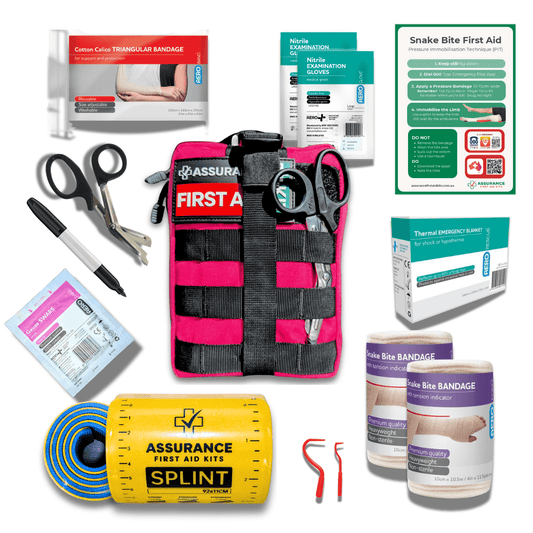
Explore our Family First Aid Kits — packed in Australia and organised for real emergencies.
📩 Free Choking Prevention Guide
We regularly share practical safety education for Australian families, including choking prevention checklists and first aid refreshers.
Stay prepared. Not panicked.

About the Author
Samantha Kerr is a First Aid Trainer based in Outback NSW with over 18 years of experience in First Aid and Allied Health. She has trained thousands of Australian parents, carers and educators in evidence-based emergency response aligned with ANZCOR guidelines.
References
- Australian and New Zealand Committee on Resuscitation (ANZCOR) – Guideline 4
- Royal Children's Hospital Melbourne – Child Safety Guidelines
- Sydney Children's Hospitals Network – Emergency Care Resources
- HealthInfoNet – Australian Child Safety Data
- CPR Kids – Paediatric First Aid Education