
Reviewed: 22 April 2025
Your Industry Has Specific First Aid Requirements — Is Your Kit Up to It?
A generic kit won't cut it on a construction site, in a remote mining camp, or in an emergency service vehicle. Find the right kit for your workplace — packed in NSW, WHS-aligned, and ready to go.
Find My Kit →As an Australian business owner or workplace manager, you have a legal duty of care to provide first aid equipment that is suitable for your specific environment. That obligation does not look the same for a concreter in western NSW as it does for an accountant in a Sydney CBD office — and a one-size kit will leave someone under-prepared when it matters most.
This guide breaks down first aid kit requirements by industry — starting with the highest-risk environments where the stakes are greatest. Whether you run a construction crew, a small trade business, an office, a retail store, or an emergency service operation, you will find the right kit and the right compliance information here.
Under the Work Health and Safety Act 2011 and Safe Work Australia's Model Code of Practice for First Aid in the Workplace, every Australian employer must provide first aid equipment that is risk-matched, accessible, in date, and appropriate for their workforce size and hazards. State regulators — including SafeWork NSW, WorkSafe Victoria, and WorkSafe QLD — enforce these obligations and conduct unannounced inspections.
Why Standard Kits Are Not Enough on a Worksite
The construction and trades industries account for some of the highest rates of serious workplace injury in Australia. According to Safe Work Australia, the construction sector consistently records among the highest rates of serious injury compensation claims nationally — with lacerations, fractures, and crush injuries among the most common incidents.
What makes high-risk worksites different is not just the type of injury but the time to treatment. On a remote site, in a roof cavity, underground, or in a confined space — help is not coming in minutes. The kit on site is the only resource available until paramedics arrive. That kit needs to be capable of managing severe bleeding, airway compromise, and traumatic injury — not just minor cuts and blisters.
Under Safe Work Australia guidance, high-risk workplaces — including construction, manufacturing, mining, and remote operations — require enhanced first aid provisions. This includes:
- A higher ratio of trained first aiders to workers
- Kits equipped for the specific hazards of the site (e.g. chemical exposure, height falls, machinery injuries)
- Trauma-capable supplies including tourniquet and haemostatic dressing where severe bleeding is a foreseeable risk
- Clear signage and accessible placement — not locked in a shed or back office
Mining, Remote Operations & Emergency Service Organisations
For operations in remote or regional Australia — mining camps, fly-in fly-out sites, outback stations, and emergency service deployments — the calculus changes again. When the nearest hospital is two hours away, your kit is not a backup plan. It is the plan.
ESOs — including SES units, rural fire brigades, and volunteer rescue associations — operate in exactly these conditions. After more than a decade volunteering with the Dubbo Volunteer Rescue Association and working as a Patient Transport Officer in outback NSW with AirMed, I know first-hand what a kit needs to contain when you are it.
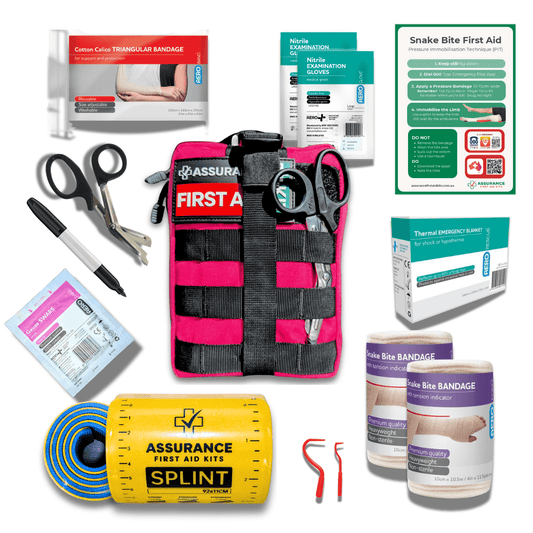
- Snake bite is a real and regular risk in regional and remote Australia — pressure immobilisation bandages are non-negotiable
- Evacuation time changes everything — your kit needs to sustain a patient for hours, not minutes
- Trauma capability — tourniquet, haemostatic gauze, and wound packing are essential where serious lacerations or penetrating injuries are foreseeable
- Environmental exposure — heat, dust, and humidity degrade supplies faster; kits must be checked more frequently
WHS Obligations for Small Businesses and Sole Traders
Many sole traders and small business owners assume that WHS obligations only apply to large employers. This is incorrect. The Work Health and Safety Act 2011 applies to all persons conducting a business or undertaking — regardless of whether you employ one person or one hundred. If you have workers, including subcontractors and labour hire, you are responsible for their access to first aid.
Mobile workers: If your workers travel between sites — tradies, delivery drivers, field technicians — each vehicle should carry a compact first aid kit appropriate for the work being performed.
Sole operators: Even if you work alone, Safe Work Australia recommends you carry a suitable kit. In a remote or regional job, you may be the only person available to help yourself.
Subcontractors: If subcontractors are working on your site, you share responsibility for their access to first aid. Confirm that adequate provisions are in place before work begins.
For most small trade businesses and sole operators, a well-equipped vehicle kit — supplemented with a site kit for larger jobs — provides the right balance of coverage, portability, and compliance. The TradeMax range is built specifically for this purpose: durable, vehicle-ready, and WHS-aligned for crews of up to 25.
Not Sure Which Kit Your Workplace Needs?
Answer a few quick questions about your workplace size, industry, and location and we will match you with the right kit — WHS-aligned and ready to go.
Find My Kit →What Low-Risk Workplaces Still Need to Get Right
Office environments, retail stores, cafes, and hospitality venues are classified as lower-risk workplaces — but WHS obligations are no less real. Compliance failures in these environments are often less about missing trauma gear and more about maintenance: expired supplies, inaccessible kits, missing signage, and staff who do not know where the kit is or how to use it.
- Kit stored in a back room, locked cabinet, or location staff do not know
- No signage indicating where the first aid kit is located
- Expired items left in kit — particularly gloves, antiseptics, and CPR shields
- No designated first aider or no staff with current first aid certification
- Kit not replenished after use
For hospitality and food service environments, burn care is particularly important — gel dressings and burn patches should be directly accessible in or near kitchen areas, not stored across the building. For retail environments with customer-facing staff, an accessible kit near the service counter and clear staff training on its location are both essential.
Compare WHS-Compliant First Aid Kits
Designed in alignment with the First Aid in the Workplace Code of Practice and Safe Work Australia guidance, these kits help businesses select the right solution with clarity and confidence. All kits are packed in NSW with clinical-grade supplies and clearly marked expiry dates.
| Product | Best For | Workplace Size | Vehicle Suitable | Wall Mountable | Action |
|---|---|---|---|---|---|
| TradeMax 5 | Tradies and mobile workers | Up to 5 | ✔ | — | View Details |
| TradeMax 10 | Small worksites and trade teams | Up to 10 | ✔ | — | View Details |
| TradeMax 25 | Construction and high-risk environments | Up to 25 | ✔ | ✔ | View Details |
| Workplace First Aid Kit – 5 Person | Offices and small workplaces | Up to 5 | ✔ | — | View Details |
| Workplace First Aid Kit – 10 Person | Medium workplaces | Up to 10 | ✔ | — | View Details |
| Workplace First Aid Box – 10 Person | Warehouses and fixed locations | Up to 10 | — | ✔ | View Details |
| Wall Mounted First Aid Kit – 5 Person | Permanent workplaces | Up to 5 | — | ✔ | View Details |
| Wall Mounted First Aid Kit – 10 Person | Warehouses and offices | Up to 10 | — | ✔ | View Details |
| Slimline Vehicle First Aid Kit | Cars and fleet vehicles | Vehicle | ✔ | — | View Details |
| Assurance Trauma First Aid Kit | High-risk workplaces and emergency response | High-Risk | ✔ | — | View Details |
| Remote Area Survival First Aid Kit | Remote worksites, mining, outback operations | Remote | ✔ | — | View Details |
| Major Bleed First Aid Kit | Critical bleeding emergencies | Specialist | — | — | View Details |
Note: Workplace first aid requirements vary based on risk assessments, workforce size, and industry. These kits are designed in alignment with the First Aid in the Workplace Code of Practice and Safe Work Australia guidance. Always conduct a workplace risk assessment before selecting your kit.
Frequently Asked Questions
Invest in Safety — Before You Need It
Choosing the right first aid kit for your workplace is not just a compliance exercise — it is a genuine commitment to the people who work with you and for you. The right kit, in the right place, with trained people who know how to use it, can be the difference between a managed incident and a tragedy.
All Assurance kits are packed in Dubbo, NSW with clinical-grade supplies, clearly marked expiry dates, and designed for real Australian conditions — not just for passing inspection.
Answer a few quick questions about your industry, workplace size, and location — we will match you with exactly the right kit.
Know your environment? Browse directly to the right collection for your industry.
Download a free audit checklist and restock only what you need — without replacing the whole kit.
References
- Safe Work Australia — Model Code of Practice: First Aid in the Workplace — safeworkaustralia.gov.au
- Safe Work Australia — Work Health and Safety Act 2011 — safeworkaustralia.gov.au
- SafeWork NSW — Construction Industry First Aid Requirements — safework.nsw.gov.au
- Better Health Channel — Workplace Safety — betterhealth.vic.gov.au
- Australian Resuscitation Council (ANZCOR) — First Aid Guidelines — resus.org.au
- Australian Venom Research Unit — Snake Bite First Aid — biomedicalsciences.unimelb.edu.au/avru
- WorkSafe Victoria — First Aid in the Workplace — worksafe.vic.gov.au