
Reviewed: 22 April 2025
Snake Bite? Kitchen Burn? Rolled Ankle at Footy?
In a real emergency, seconds count — and a junk kit will let you down. Answer a few quick questions and we'll match you with a kit built for your actual life.
Find My Kit →Walk into any pharmacy, hardware store, or click through any online marketplace and you will find hundreds of first aid kits. Most of them are not worth your money. Some of them are genuinely dangerous — particularly those sold with fake or substandard trauma gear. And almost none of them are designed with Australian conditions in mind.
This guide is different. It is built on 19 years of hands-on first aid training across regional and metropolitan NSW — working with schools, tradies, workplaces, farms, sports teams, and families who have actually needed to use their kits in a real emergency. This is what I have learned about what makes a first aid kit worth having.
Assurance First Aid Kits is based in Dubbo, NSW. We train paramedics, teachers, tradies, and parents. Our kits are used across schools, worksites, farms, campsites, and homes. Everything we recommend meets or exceeds current WHS Code of Practice — and it is all field-tested, not just shelf-tested.
How to Spot a First Aid Kit That Is Actually Useful
The difference between a good kit and a useless one is not always obvious from the outside. Here is what to look for before you buy.
-
Organised, not chaotic Look for labelled sections, colour coding, and a layout that opens clearly — not a bin of loose bandaids you have to tip out to find anything. In an emergency, you need to find what you need in seconds.
-
Clinical-grade supplies Hospital-grade dressings. Bandages that actually stick. Scissors and tweezers that do not bend or snap under pressure. The difference between clinical-grade and retail-grade supplies is significant — and it shows up exactly when you need it most.
-
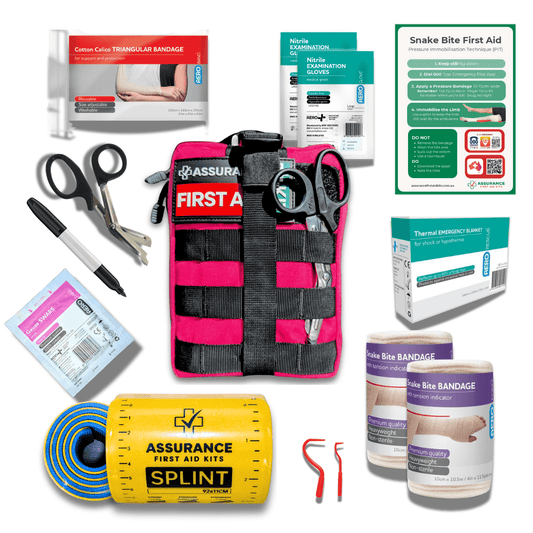
Real trauma gear for Australian conditions If your kit does not include a pressure immobilisation bandage with a tension indicator, burn gel, and a CPR face shield, it is not equipped for Australia. If it cannot help in a real emergency — snake bite, severe burn, cardiac arrest — it should not be in the kit.
-
Refillable and maintainable A good kit has clear expiry dates on every item and allows you to top up consumables individually. You should never have to replace an entire kit just because a few items have expired.
-
Clear instructions for non-trained users Most people who reach for a first aid kit are not trained first aiders. The best kits include visual step-by-step guides, a quick-start layout, and instructions written in plain language — because panic is not the time to decode jargon.
Pick the Right Kit for Your Life
The single biggest mistake Australians make when buying a first aid kit is choosing by price rather than by purpose. A kit that works perfectly in a city office can be dangerously inadequate in the bush. Here is how to match your kit to your actual situation.
🏠 For Families
Kids plus life equals cuts, burns, bites, fevers, and moments you did not see coming. A family kit should cover the everyday and the unexpected — including a snake bite bandage if you are anywhere near bushland.
Shop Family Kits🏕️ For Outdoor Adventures
If you are more than 10 minutes from help, do not trust your life to a kit from a chemist shelf. Remote travel in Australia demands trauma-ready gear — full stop.
Shop Outdoor Kits🏗️ For Workplaces
Workplace kits must meet WHS requirements — accessible, auditable, clearly marked, and matched to your specific hazards. Generic kits often fail inspection and fail workers.
Shop Workplace Kits⚽ For Sports Teams
Keep it field-ready, not buried in a back room. Sports kits need cold packs, strapping tape, antiseptic, and gloves — organised for quick access on the sideline.
Shop Sports KitsStill Not Sure Which Kit Is Right for You?
Use our free kit finder — answer a few quick questions about your situation and we'll recommend the right kit for your home, vehicle, workplace, or adventure.
Find My Kit →The Biggest First Aid Kit Mistakes — and How to Avoid Them
After 19 years in the field, I have seen the same mistakes repeated by well-meaning people who simply did not know what to look for. Here is what to watch out for.
| The Mistake | Why It Matters | What to Do Instead |
|---|---|---|
| Buying by item count | That "300-piece kit" is often 250 cotton buds and a handful of tiny bandaids. Volume means nothing if the items are not fit for purpose. | Buy by content quality and scenario coverage — not number of pieces. |
| Choosing the cheapest option | A $29 kit typically comes with scissors that bend, dressings that do not adhere, and bandages that have no elasticity. In a trauma situation, these fail. | Invest in clinical-grade supplies from a TGA-registered Australian supplier. |
| Never checking or restocking | Expired consumables, degraded sterile packaging, and missing items mean your kit is useless exactly when you need it. A kit you do not maintain is dead weight. | Check your kit every 12 months. Restock with quality replacements. |
| Wrong kit for the environment | A city office kit in the outback. A hiking kit at a construction site. Mismatched kits leave real hazards unaddressed. | Match your kit to your actual environment and risk profile — use the kit finder if unsure. |
| No plan, no training | A kit no one knows how to use — or cannot find in a crisis — is as useful as no kit at all. Equipment without knowledge is just plastic and packaging. | Make sure everyone in your household or team knows where the kit is and what to do. Consider a first aid course. |
| Counterfeit trauma gear | Fake tourniquets are sold online across Australia and can snap or fail under pressure. The consequences can be fatal. | Only buy from TGA-registered suppliers. Authentic CAT, SOF-T, and RapidStop tourniquets cost $65–$100. If it costs less, ask why. |
We have spotted trauma kits sold through major Australian online marketplaces containing tourniquets that snap under even moderate tension. Always purchase trauma supplies from a TGA-registered Australian supplier. If you are unsure about gear you already own, reach out via the live chat on our site — you will be speaking directly with Samantha.
Free First Aid & AED Wall Signs
Every workplace, school, and sports club in Australia is required to clearly display the location of first aid equipment. Our free, print-ready wall signs help you stay compliant — and help people find what they need in the moments that matter most.
Designed to Australian standards. Print at home or send to a printer. No sign-up required.
Download Your Free Signs →
Frequently Asked Questions
Want a Kit That Is Actually Ready?
Every Assurance kit is built and packed in Dubbo, NSW — by trainers who teach real first aid to real Australians. No imported fillers, no expired stock, no guessing. Clinical-grade supplies, organised for fast response, designed for Australian conditions.
Choose the option that suits your situation:
Not sure where to start? Answer a few quick questions and we'll match you with exactly the right kit — for your home, workplace, vehicle, or next adventure.
Know what you need? Browse the full Assurance range by environment, activity, or workplace type — all kits built to Australian standards.
Save money and reduce waste — restock your existing kit with clinical-grade replacements rather than starting from scratch.
References
- Safe Work Australia — Model Code of Practice: First Aid in the Workplace — safeworkaustralia.gov.au
- Australian Resuscitation Council (ANZCOR) — First Aid Guidelines — resus.org.au
- Better Health Channel — First Aid Kits — betterhealth.vic.gov.au
- NSW Health — First Aid in the Home — health.nsw.gov.au
- Australian Venom Research Unit — Snake Bite First Aid — biomedicalsciences.unimelb.edu.au/avru
- SafeWork NSW — Workplace First Aid Requirements — safework.nsw.gov.au