
Updated March 2026
Recent public emergencies in Australia have reminded us of something important: severe bleeding can become life-threatening in minutes.
Whether it’s a violent incident in a public space, a shark attack at the beach, a serious car crash, or a machinery accident at home — everyday Australians are often the first on scene.
Senior emergency physician Dr Stephen Parnis, who is frequently consulted in national media following major incidents, has consistently emphasised that early action before hospital arrival can influence survival in time-critical trauma.
You don’t need to be a paramedic to make a difference. With calm action and clear knowledge, you can help control life-threatening bleeding before emergency services arrive.
Why Severe Bleeding Is So Dangerous
According to the Australian and New Zealand Committee on Resuscitation (ANZCOR), life-threatening bleeding must be controlled immediately using firm direct pressure and, when required, a tourniquet.
Severe bleeding becomes critical when:
- Blood is spurting or pouring heavily
- Clothing becomes soaked rapidly
- A limb is partially or completely amputated
- The person becomes pale, dizzy, confused or collapses
Professor Gordian Fulde, a pioneer of emergency medicine in Australia, has long advocated for structured emergency response systems that prioritise rapid identification and control of life-threatening injury.
Uncontrolled blood loss can quickly lead to shock and cardiac arrest. Early action matters.
How to Stop Severe Bleeding – Step by Step
Step 1: Make the Area Safe and Call 000
- Check for ongoing danger.
- Call 000 immediately.
- Put on gloves if available.
If alone, use speakerphone and begin first aid while speaking with the operator.
Step 2: Apply Firm, Direct Pressure
This is the most important action.
- Expose the wound.
- Place a dressing or dense cloth directly over it.
- Press hard.
- Maintain continuous pressure.
Do not keep lifting the dressing to check the wound. If blood soaks through, apply more material on top and keep pressing.
Bleeding stops because something compresses it — not because something absorbs it.
⚠️ Common Mistake: Grabbing a Towel
This is one of the most common errors we hear in training.
Towels are designed to absorb fluid. They are not designed to compress wounds.
A fluffy towel can:
- Wick blood away from the wound
- Mask ongoing blood loss
- Create false reassurance
- Encourage repeated lifting and checking
Absorption does not stop arterial bleeding. Pressure does.
What To Use Instead (If You Don’t Have a Kit)
- Tightly packed T-shirt
- Sarong or beach wrap
- Cotton dress or long sleeve shirt
- Hoodie folded into a dense pad
Pack firmly into the wound (if deep) and apply hard, continuous pressure.
Pre-hospital emergency specialist Bill Griggs, known for disaster and trauma response leadership in Australia, has highlighted the importance of decisive early intervention before advanced care arrives.
Step 3: Use a Tourniquet for Life-Threatening Limb Bleeding
If severe bleeding from an arm or leg does not stop with direct pressure:
- Apply a tourniquet above the wound (closer to the body).
- Tighten until bleeding stops completely.
- Note the time applied.
ANZCOR guidelines support tourniquet use in life-threatening limb haemorrhage when direct pressure fails.
Proper tourniquets are safer and more effective than improvised options like belts.
Step 4: Treat for Shock
- Lay the person flat.
- Keep them warm.
- Reassure them.
- Do not give food or drink.
- Monitor breathing until paramedics arrive.
Purpose-Built Trauma Kits Make a Difference
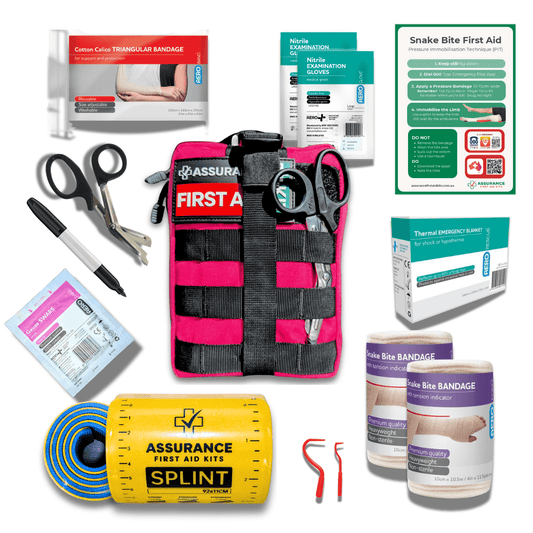
Improvised methods can buy time. Purpose-built trauma kits are designed for catastrophic bleeding control and align with national first aid recommendations from ANZCOR and Safe Work Australia.
📦 Relevant First Aid Kits
| Kit Name | Best For | Link |
|---|---|---|
| IFAK Hike | Bushwalking & remote areas | View Product |
| Remote Area Survival First Aid Kit | Isolated emergencies | View Collection |
| IFAK Survival First Aid Kit | Everyday emergency carry | View Collection |
| Assurance Trauma First Aid Kit | Public & community emergencies | View Product |
| Major Bleed First Aid Kit | Rapid catastrophic bleeding | View Product |
Explore more:
OH SHI*T First Aid Kits
Trauma & Bleed Control Kits
Watch: How to Apply Pressure For Severe Bleeding with a Plain First aid Kit
This short video demonstrates how you can use a basic first aid kit to help control life threatening bleeding on a limb.
Frequently Asked Questions
How long should I apply pressure?
Until bleeding stops or paramedics take over. Do not lift the dressing to check.
When should I use a tourniquet?
When severe limb bleeding does not stop with firm direct pressure.
Can I use a belt as a tourniquet?
Belts are unreliable and often fail to stop arterial bleeding completely.
Should I remove an object stuck in a wound?
No. Apply pressure around the object and wait for emergency services.
Be Prepared, Not Panicked
You can’t predict public emergencies. But you can prepare.
With the right knowledge — and the right kit — you’re not relying on improvisation alone.
Feel confident. Stay prepared. Built for Australia.
References
- Australian and New Zealand Committee on Resuscitation (ANZCOR) – Guideline 9.1.1: First Aid Management of Bleeding
- NSW Health – Trauma and Emergency Response Information
- Better Health Channel – First Aid for Bleeding
- Safe Work Australia – First Aid in the Workplace Code of Practice
- Australian Government Department of Health – Emergency Medical Response Information
- Public commentary and professional profiles of Dr Stephen Parnis, Professor Gordian Fulde, and Bill Griggs relating to emergency medicine and trauma response in Australia