
Someone recently told me, in the comments on one of my videos, to put a nicotine patch on a snake bite. Someone else swore by drinking your own urine. I've been teaching first aid for 18 years and I'm still hearing new ones. So let's look at what Australian snake venom actually does once it's inside you, because once you understand that, the right first aid makes sense and the folk remedies fall over on their own.
Nicotine patches, urine and brandy: what people have tried
Australians have been inventing snake bite cures for as long as we've been getting bitten. Every one of these has been used, sold or recommended at some point. None of them work.
| What people tried | Why it doesn't help |
|---|---|
| A tight tourniquet | Australian venom moves mainly through the lymphatic system, not the veins. A tourniquet cuts off blood to the limb without stopping the venom. |
| Cutting the bite and sucking it out | The venom is already spreading through the tissue. Cutting adds a wound and infection risk, and sucking gets back almost nothing. |
| Washing the bite with urine (it's printed in my 1950s kit) | Don't wash the bite at all, with anything. Venom left on the skin can help the hospital work out what they're dealing with. |
| Drinking urine | It does nothing for venom. And the patient shouldn't eat or drink anything while waiting for help. |
| A nicotine patch | There's no evidence it does anything for a snake bite. Nicotine is a drug in its own right, and it won't slow venom. |
| Brandy, rum or whisky | Alcohol was a colonial favourite. It does nothing to venom and gets in the way of hospital care. No alcohol. |
| Condy's crystals rubbed into the wound | Potassium permanganate burns tissue. Once common in kits, it is now known to cause harm with no benefit. |
| Strychnine or ammonia injections | Both were promoted by doctors in the 1800s. Both are dangerous, and neither treats envenoming. |
| Smelling salts (sal volatile) | These might help someone who's fainted. They do nothing for the effects of venom. |

If you want to see what this looked like in real life, I've pulled apart a 1950s snake bite kit step by step, and written about why cut-and-suck was so wrong.
What is snake venom?
Venom is a mix of proteins and enzymes a snake uses to stop its prey and defend itself. It varies between species, and even within one species depending on age and where the snake lives. Not every bite injects venom (a "dry bite"), but you can't tell that by looking. Treat every bite as an emergency.
How venom moves through the body
This is the bit that changed everything. When you're bitten on a limb, the venom travels first through your lymphatic system, a slow network of vessels just under the skin. Muscle movement is what pumps it along.
So the answer is to stop the pump. A firm bandage squeezes those vessels, and keeping still stops the muscles pushing venom along. That's the Pressure Immobilisation Technique, and it came from one Australian scientist's work in 1979.
The four things Australian venom goes after
Your blood
The most common serious effect in Australia. The venom uses up your clotting factors, so your blood stops clotting properly. You might see bleeding gums, oozing from the bite, or bruising. Brown snakes, tiger snakes and taipans are well known for this, which is why hospitals run clotting blood tests after every suspected bite.
Your nerves
Neurotoxins block the signal between nerves and muscles. It often starts with droopy eyelids, blurred or double vision and slurred speech, then trouble swallowing. In severe cases it reaches the muscles you breathe with. Taipans, death adders and tiger snakes can all cause this.
Your muscles
Some venoms break down muscle tissue. That shows up as muscle pain and tenderness, weakness and dark (cola-coloured) urine. Tiger snakes, mulga (king brown) and other black snakes, taipans and sea snakes can all do this.
Your kidneys
Kidneys often take the hit from the other three: broken-down muscle and damaged blood cells clog them up. Brown snake bites in particular can lead to kidney injury, sometimes days later. That's one reason follow-up blood tests matter.

The thing that catches people out
Many Australian snake bites barely hurt. There may be little swelling and fang marks you can hardly see. People brush it off as a scratch or a stick. If there's any chance it was a snake, treat it as a bite.
Symptoms to watch for (minutes to hours)
- At the bite: sometimes pain or swelling, often very little.
- Early signs: headache, nausea, vomiting, stomach pain, dizziness or collapse.
- Nerves: droopy eyelids, blurred or double vision, slurred speech, trouble swallowing.
- Breathing: shallow or laboured breathing.
- Bleeding: from the gums, nose or bite site, or unexplained bruising.
- Muscles: pain, weakness, dark urine.
No symptoms doesn't mean no venom. Symptoms can take hours to show, so every suspected bite goes to hospital.
What to do if someone is bitten (ANZCOR)
- Call Triple Zero (000).
- Keep them still and calm. Lie them down. No walking to the car.
- Apply a pressure immobilisation bandage. On a limb, bandage firmly over the bite first. Then use a second bandage from the fingers or toes all the way up the limb, as high as you can go. Mark where the bite is on the bandage.
- Splint the limb so it can't move.
- Don't wash, cut or suck the bite, use a tourniquet, or give food, drink or alcohol.
- Watch their breathing. Be ready to start CPR if they become unresponsive.
- Stay with them until paramedics arrive.
If you've never done it, practise now. Here's how to apply a snake bite bandage correctly, or watch me do it.
These steps follow ANZCOR Guideline 9.4.1 (Australian Snake Bite).
The recovery most people don't plan for
We talk a lot about first aid and antivenom, but recovery takes time too.
- Rest and rehab: muscle damage can mean physio and a gradual return to work.
- Follow-up tests: your doctor may check your kidneys and clotting after you go home.
- Confidence: it's normal to feel uneasy outdoors afterwards. A few walks on familiar tracks with someone you trust, and a kit in your pack, can help.
Keep snakes away
- Keep lawns short, clear rubbish and woodpiles, seal shed gaps and control mice.
- Wear boots and long pants in long grass, and carry a torch at night.
- Never try to catch or kill a snake. Most bites happen that way. Call a licensed catcher.
- Know when they're about. Here's what snakes do over the cooler months.
Have the right gear on hand
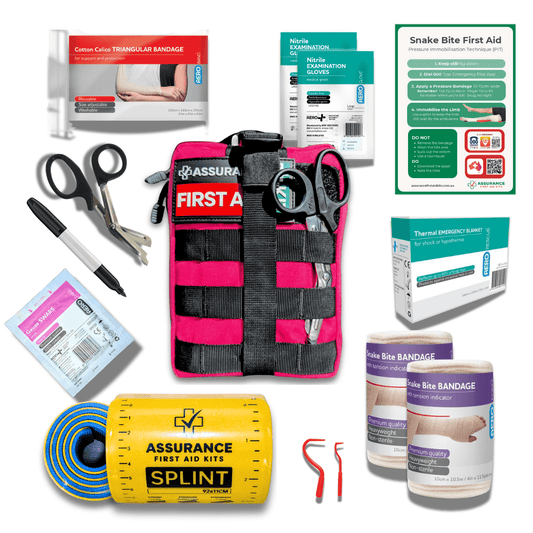
A snake bite kit gives you broad elastic bandages and what you need to splint, ready to go. I keep one in the car, one in my daypack and one at home.
FAQ
Do I need to identify the snake?
No, and don't try to catch or kill it. Apply the bandage, call 000 and keep still. The hospital works out treatment from symptoms and blood tests.
What if the bite isn't on a limb?
Apply firm pressure over the bite if you can, keep the person completely still and wait for the ambulance.
Do nicotine patches, urine or alcohol help?
No. None of them affect venom, and some cause harm. Bandage, keep still and call 000.
Are snake bites usually fatal?
Deaths in Australia are rare, about two a year, thanks to good first aid and antivenom. But a bite can still make you very sick, so treat every one seriously.
Keep reading
- 1950s Snakebite Kit vs Modern First Aid: How Far We've Come
- The Cut-and-Suck Myth: Why the 1950s Snakebite Kit Was Dangerously Wrong
- How One Australian Scientist Changed Snakebite First Aid Forever
- How to Apply a Snake Bite Bandage Correctly