
Reviewed: 30 April 2026
🐍 Not sure which snake bite kit is right for you? Find yours in 60 seconds.
Find My Kit →In 1979, a Melbourne toxicologist quietly changed the way Australia — and eventually the world — responds to snakebite. His name was Dr Struan Sutherland, and the technique he developed at the Commonwealth Serum Laboratories is the reason that pressure immobilisation bandaging is now the standard of care for snakebite across Australia and beyond.
Before his research, Australians treated snakebite with tourniquets, incision, suction, and smelling salts — an approach that had remained largely unchanged since the 1800s. It was ineffective, and in some cases actively dangerous. Sutherland's insight — that Australian elapid venoms travel through the lymphatic system, not the bloodstream — overturned decades of accepted practice and gave first aiders a tool that genuinely buys time.
As a first aid trainer with 19 years of experience and someone who has worked in remote outback environments where the nearest hospital can be hours away, I teach pressure immobilisation bandaging as a non-negotiable skill. Understanding why it works — and the remarkable story behind its discovery — makes people take it seriously. This article tells that story.
What Australians Need to Know About Pressure Immobilisation Bandaging
Australia has more venomous snake species than any other country. Brown snakes alone are responsible for the majority of snakebite fatalities here. Tiger snakes, taipans, death adders, copperheads, and black snakes all carry venom capable of causing serious harm or death without appropriate treatment.
What makes Australian snakes biologically distinct from many other venomous species worldwide is the nature of their venom and the way it enters the body. Most Australian land snakes belong to the elapid family — they deliver neurotoxic, coagulation-disrupting venom through small, fixed fangs. This venom does not pool at the bite site. It is absorbed almost immediately into the lymphatic system, which drains tissue fluid and feeds it into the bloodstream.
This is the key fact that everything else depends on. The lymphatic system has no pump — unlike the heart driving blood circulation, lymph moves slowly through vessels and lymph nodes, driven largely by muscle movement. That slow movement is what makes pressure immobilisation effective: firm bandaging compresses the lymphatic vessels, and immobilisation removes the muscular contractions that drive lymph flow. Together, they dramatically slow the rate at which venom reaches the bloodstream.
Understanding this is also why the old approach was so wrong. Tourniquets act on blood vessels, not lymphatic vessels. Incision and suction target a venom "pool" that doesn't exist in elapid bites. The entire cut-and-suck protocol was built on a misunderstanding of the biology.
The Story of a Discovery: How PIT Was Developed
Australian snakebite treatment follows the cut-and-suck protocol — tourniquet above the bite, incision at the site, mechanical suction, antiseptic, and smelling salts for shock. This approach, largely unchanged from the 19th century, is standard practice in first aid kits across the country. It is based on the assumption that venom travels through surface blood vessels and can be physically extracted.
Dr Struan Sutherland, a toxicologist at the Commonwealth Serum Laboratories (CSL) in Melbourne, begins researching Australian snake venoms in depth. CSL is already the leading producer of Australian antivenoms — Sutherland's work focuses on understanding exactly how venom spreads through the body and what first aid interventions actually slow that process.
Sutherland publishes his landmark research demonstrating that Australian elapid venoms travel via the lymphatic system, not the bloodstream. He develops and tests pressure immobilisation bandaging — firm bandaging applied over the bite site and up the limb, combined with complete immobilisation — and shows it significantly delays venom reaching the circulation. His paper is published in the Medical Journal of Australia and the technique is formally recommended for Australian snakebite first aid.
The pressure immobilisation technique is gradually adopted into Australian first aid training and workplace safety guidelines. Resistance from some quarters — particularly those accustomed to the older method — slows uptake, but clinical evidence continues to support Sutherland's approach. The cut-and-suck protocol begins to disappear from mainstream first aid guidance.
Sutherland also develops the first funnel-web spider antivenom, cementing his legacy as one of Australia's most important figures in toxinology. His work on both snakes and spiders fundamentally reshapes how Australians think about envenomation and its treatment.
Pressure immobilisation bandaging is the standard ANZCOR-recommended first aid for all Australian elapid snake bites. It is taught in every accredited Australian first aid course and is the basis for every properly designed snake bite kit sold in the country — including those from Assurance First Aid Kits. The cut-and-suck method is not just obsolete; it is now considered contraindicated.
Why Pressure Immobilisation Bandaging Actually Works
The mechanics of PIB are elegantly simple once you understand the lymphatic system. Lymph vessels run throughout the body's tissue, collecting excess fluid and delivering it — along with any absorbed toxins — into the bloodstream via the thoracic duct. Unlike blood, lymph doesn't have a dedicated pump. It moves via three mechanisms: the gentle pressure of surrounding tissue, contractions of smooth muscle in lymph vessel walls, and — most significantly — skeletal muscle movement.
When you walk, run, or even flex your arm, the surrounding muscles compress lymph vessels and push fluid along. This is why exercise helps reduce swelling, and also why movement after a snake bite is so dangerous — every muscle contraction accelerates venom distribution.
PIB works against both drivers of lymph flow:
- The pressure bandage compresses the lymphatic vessels directly, physically slowing the flow of venom-laden lymph fluid away from the bite site.
- Immobilisation removes the muscular pumping action that would otherwise drive lymph movement, keeping venom localised for as long as possible.
Together, these two elements can delay systemic envenomation significantly — potentially by several hours. In a country where hospital access from remote areas can take hours, that delay can be the difference between life and death.
First Aid Steps — As per ANZCOR Guidelines
These steps reflect the current ANZCOR (Australian and New Zealand Committee on Resuscitation) guidelines for snake bite first aid. They are based directly on the pressure immobilisation technique developed by Dr Sutherland and refined through decades of clinical evidence.
- Call 000 immediately. Do not wait for symptoms. Snake bite is always a medical emergency, even if the patient feels fine initially — some envenomations have delayed symptom onset.
- Keep the patient calm and completely still. Have them lie down. Prevent all unnecessary movement — every movement of the affected limb accelerates venom spread through the lymphatic system.
- Do not wash, wipe, or interfere with the bite site. Venom residue on the skin allows hospitals to identify the snake species using a venom detection kit, directing the correct antivenom.
- Apply a broad pressure bandage firmly over the bite site. Use a bandage at least 10–15 cm wide — a crepe or conforming bandage is ideal. Pressure should be firm, as for a sprained ankle: tight enough to restrict lymph flow but not so tight it cuts off circulation to fingers or toes.
- Continue bandaging up the entire limb toward the torso. Cover as much of the limb as possible. For a lower limb bite, bandage from the foot to the groin. For an upper limb bite, from the hand to the shoulder.
- Immobilise the limb with a splint. Use whatever is available — a rigid stick, rolled clothing, or a purpose-made splint. The goal is to prevent all bending at joints, which drives lymph movement.
- Mark the bite site on the outside of the bandage. Write the location, the time of the bite, and the time the bandage was applied. This information is critical for treating medical staff.
- Keep the patient lying flat and still until help arrives. If evacuation is essential, carry — do not allow walking. Movement is the enemy of PIB.
- Do not remove the bandage. The bandage must remain in place until the patient is at hospital and antivenom is prepared. Removing it causes a sudden venom surge into the bloodstream.
Pressure Immobilisation vs the Old Approach: At a Glance
| Factor | Cut-and-Suck (Pre-1979) | Pressure Immobilisation (ANZCOR) |
|---|---|---|
| Based on | Assumption venom travels via bloodstream | Evidence that elapid venom travels via lymphatic system |
| First action | Apply tourniquet above bite | Call 000, keep patient still |
| Bite site treatment | Incise with lancet, apply suction pump | Do not touch — apply bandage over the site |
| Effect on venom | Negligible — venom already absorbed into lymphatics | Delays lymphatic transport significantly |
| Infection risk | High — incisions introduce bacteria | None — no wound created |
| Venom identification | Washing/cutting destroys residue on skin | Residue preserved for hospital venom detection kit |
| Clinical outcome | Ineffective; potentially harmful | Delays systemic envenomation; saves lives |
| Current status | Contraindicated — do not use | ANZCOR-recommended standard of care |
Kits Built Around the Science: Assurance Snake Bite Range
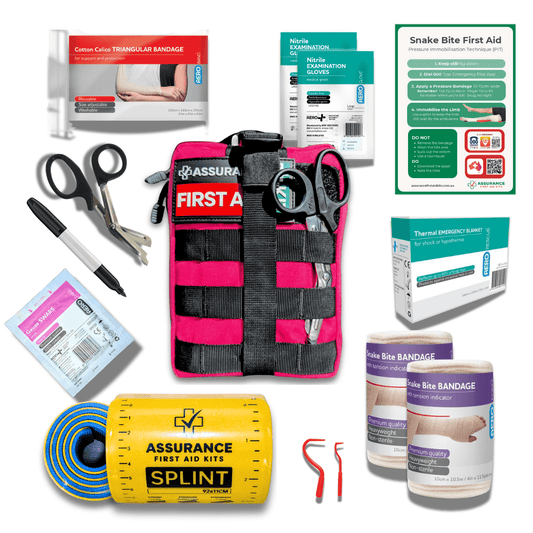
Every kit in the Assurance snake bite range is built around pressure immobilisation — the technique Dr Sutherland's research made possible. The right kit for you depends on where you are and how remote your situation might be.
| Kit | Best For | Key Contents | Shop |
|---|---|---|---|
| Assurance Snake Bite Kit | Home, vehicle, regional households | Snake bite bandages with indicators, gloves, instructions | Shop Now |
| Snake Bite Plus Kit | Families, farms, outdoor workers | Extended bandage supply, additional trauma items | Shop Now |
| Snake Bite Pink Plus Kit | Full Plus kit in high-visibility hot pink | Complete Plus contents — easy to spot in a bag or vehicle | Shop Now |
| Snake Bite Max Kit | Remote workplaces, extended expeditions | Maximum bandage supply, cold pack for redback bites, comprehensive trauma support | Shop Now |
If you already carry a general first aid kit, check whether it includes snake bite bandaging — the Family First Aid Kit, Outdoor First Aid Kit, IFAK Hike, and IFAK Hike Lite all do.
You can also purchase a Snake Bite Bandage with Indicator (suits legs) individually to supplement an existing kit.
Watch: Understanding Pressure Immobilisation Bandaging
Samantha demonstrates the correct application of pressure immobilisation bandaging — and explains the science behind why it works. If you've never practised this technique, this is the place to start.
Frequently Asked Questions
Who invented pressure immobilisation bandaging?
Dr Struan Sutherland, a toxicologist at the Commonwealth Serum Laboratories in Melbourne, developed and published the pressure immobilisation technique in 1979. His research demonstrated that Australian elapid venoms travel via the lymphatic system — not the bloodstream — and that firm bandaging combined with limb immobilisation significantly delays venom reaching the circulation. His work transformed Australian snakebite first aid and influenced international practice.
How tight should a pressure immobilisation bandage be?
The bandage should be applied at the same firm pressure you would use for a sprained ankle — tight enough to restrict lymph flow but not so tight it cuts off circulation. A useful check: you should be able to slide a finger under the bandage, but it should feel snug. If fingers or toes beyond the bandage become cold, numb, or blue, the bandage is too tight and should be slightly loosened.
Can I use a regular bandage for pressure immobilisation?
A broad crepe or conforming bandage — at least 10–15 cm wide — is recommended. Snake bite bandages with pressure indicator markings (such as those in Assurance kits) make it easier to apply the correct level of pressure, as the indicator shows when you have reached the right tension. In an emergency, any broad stretchy bandage can be used, or clothing torn into strips, but purpose-made snake bite bandages give you the best chance of correct application under pressure.
Does pressure immobilisation work for all snake bites in Australia?
Pressure immobilisation bandaging is recommended for bites from all Australian elapid land snakes — including brown snakes, tiger snakes, taipans, death adders, copperheads, and black snakes. It is not typically recommended for redback spider bites (ice and analgesia are used instead) or sea snake bites in some circumstances. When in doubt, apply PIB and call 000. Hospital staff will assess the appropriate treatment based on venom identification.
What happens if I remove the bandage before reaching hospital?
Removing the pressure immobilisation bandage before antivenom is ready causes a sudden rapid surge of venom into the bloodstream — a phenomenon sometimes called the "release effect." This can trigger rapid deterioration in the patient's condition. The bandage must remain in place until medical staff remove it in a controlled setting with antivenom prepared and ready to administer.
The Science Exists. Now Make Sure You're Ready.
Dr Sutherland's 1979 discovery gave us a technique that works. But a technique is only as useful as the equipment you have on hand. An Assurance snake bite kit gives you ANZCOR-aligned bandaging ready to go — wherever you are in Australia.
Samantha suggests one of the following options:
Related Reading
- How to Apply a Snake Bite Bandage Correctly in Australia (Step-by-Step)
- What Does Snake Venom Do in the Body? Australian First Aid Guide
- Why It Is Important to Practice Snake Bite First Aid in Australia
- Australian Snakes: Breeding Habits & Snake Bite Safety 2026
References
- Australian Resuscitation Council — Envenomation — Snakebite (Guideline 9.4.1) — resus.org.au
- Australian Venom Research Unit, University of Melbourne — Snake Bite First Aid and Research — biomedicalsciences.unimelb.edu.au/avru
- Better Health Channel, Victorian Government — Snake Bite — betterhealth.vic.gov.au
- NSW Health — Snake Bite: First Aid and Prevention — health.nsw.gov.au
- Australian Department of Health — Venomous Bites and Stings — health.gov.au
- ABC Health & Wellbeing — Snake Bites: What You Need to Know — abc.net.au/health