
Reviewed: 30 April 2026
🐍 Ready to upgrade from outdated to evidence-based? Find the right kit for you.
Find My Kit →A few weeks ago I held a piece of Australian first aid history in my hands — a complete, original-contents Dayspring Venomous Bite Outfit, manufactured in Auburn, NSW, sometime in the 1940s or 1950s. The tin was intact. The labels were readable. The copper suction pump, the rubber tourniquet, the lancet, the antiseptic bottle, and the sal volatile were all present exactly as they were when the kit was packed.
As a first aid trainer with 19 years of experience — and someone who has worked as a Patient Transport Officer in remote Outback NSW — looking inside that tin was equal parts fascinating and sobering. Every single item in it has since been shown to be either ineffective or actively harmful for snakebite treatment.
This article puts that vintage kit side by side with what a modern, ANZCOR-aligned snake bite kit actually contains — and explains why the difference matters, whether you're in western NSW, out on a trail, or simply want to be prepared at home.
What Australians Need to Know About Snake Bite Preparedness
Australia is home to more venomous snakes than any other country. Eastern brown snakes — responsible for the majority of snakebite fatalities — are found across most of the eastern and central states, including heavily populated areas of NSW, Victoria, and Queensland. Tiger snakes range across southern Australia and Tasmania. Taipans inhabit Queensland and Northern Territory. Death adders were once widespread before cane toad spread decimated their populations, but remain present across the north.
Despite this, research consistently shows that most Australians do not carry correct snakebite first aid equipment. A 2020 study published in the Medical Journal of Australia found that pressure immobilisation bandaging — the only evidence-based first aid intervention for elapid snake bite — is still widely misunderstood or incorrectly applied in the community. Many people still believe in washing the wound, applying a tourniquet, or attempting suction.
That gap between what people think they should do and what the evidence says is exactly what this article — and the Assurance snake bite range — is designed to close.
Then vs Now: Inside Each Kit
Here is what the 1950s Dayspring Venomous Bite Outfit contained — and what replaces each item in a modern, evidence-based kit.
❌ 1950s Dayspring Kit
- Rubber tourniquet ligature
- Copper barrel suction pump (piston-action)
- Blue-handled lancet (scarifier) for cutting the bite site
- Small antiseptic bottle
- Sal volatile (smelling salts) for shock
- Printed instructions: cut, suck, tourniquet
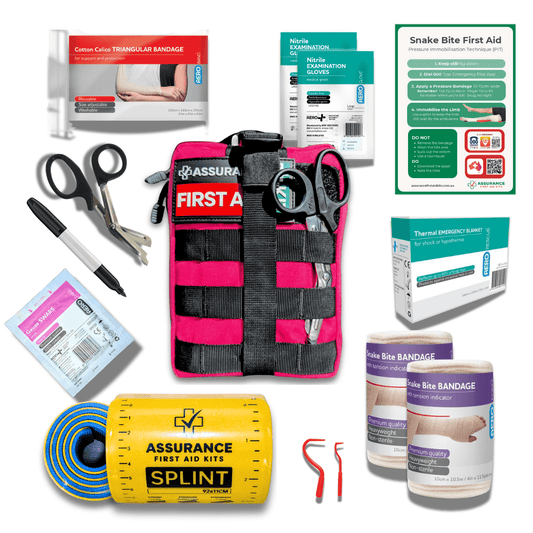
✅ Modern Assurance Snake Bite Kit
- Broad pressure bandages with indicator markings
- Conforming bandages for full limb coverage
- Disposable gloves (for the responder's safety)
- ANZCOR-aligned instruction card
- Rigid splint material (Max kit)
- Cold pack for redback bites (Max kit)
The contrast isn't just about what's different — it's about what has been removed entirely. There is no cutting tool in a modern snake bite kit. No suction device. No tourniquet. Every item that once seemed essential has been replaced by a single, evidence-based intervention: pressure and immobilisation.
Item-by-Item: What Replaced What — and Why
The Rubber Tourniquet → Removed Entirely
The tourniquet was intended to stop venom spreading through the bloodstream. The problem: Australian elapid venom travels through the lymphatic system, not blood vessels. A tourniquet has no effect on lymphatic flow. Worse, it causes ischaemia — cutting off blood supply to the limb — which concentrates venom locally, causes tissue damage, and can lead to serious complications. No modern ANZCOR-aligned kit includes a tourniquet for snakebite. It has been replaced by the pressure bandage, which acts on lymphatic vessels instead.
The Suction Pump → Removed Entirely
The copper suction pump was designed to extract venom from the wound. Research has shown it extracts negligible amounts — by the time suction is applied, the venom has already been absorbed into lymphatic tissue. Suction also risks increasing blood flow to the area, potentially accelerating absorption. The modern replacement is pressure from above: the bandage compresses lymphatic vessels from the outside, slowing the movement of venom-laden fluid rather than attempting to pull it out.
The Lancet (Scarifier) → Removed Entirely
The lancet was used to cut an X over the fang marks to "open" the bite for suction. This is now understood to be harmful on multiple levels: it creates additional trauma at the site, introduces bacteria from the skin surface and the responder's hands, and destroys the fang mark evidence that hospitals use to identify the snake species via venom detection kits. No incision should ever be made at a snake bite site. Modern kits contain no cutting tools.
The Antiseptic → Replaced by Instruction Not to Disturb the Site
Antiseptic application was a reasonable instinct in an era when the bite site was being cut open. In a modern context, applying anything to the bite site — including antiseptic — risks washing away residual venom on the skin surface. That residue is used by hospital staff to identify the snake species via a venom detection kit, which determines the correct antivenom. The modern instruction is clear: do not wash, wipe, or treat the bite site. Apply the bandage over it.
Sal Volatile (Smelling Salts) → Removed Entirely
Smelling salts can briefly stimulate alertness in a fainting person, but they have no effect on envenomation-induced shock, which requires antivenom and hospital-level intervention. The modern equivalent is calling 000 immediately and keeping the patient calm and still — reducing muscle activity and slowing lymphatic flow — until paramedics arrive.
What's New: The Pressure Indicator Bandage
The most important innovation in modern snake bite kits is the pressure bandage with visual indicator markings. These bandages are printed with a pattern — typically oval or rectangular shapes — that distort as the bandage is stretched. When the correct tension is reached, the pattern indicates the right level of pressure. This removes one of the biggest sources of error in pressure immobilisation: applying the bandage too loosely (ineffective) or too tightly (cuts off circulation). For more on correct technique, see our step-by-step bandaging guide.
Full Comparison: 1950s Kit vs Modern Assurance Kit
| Feature | 1950s Dayspring Kit | Modern Assurance Kit |
|---|---|---|
| Based on | Pre-1979 assumption (venom in blood) | ANZCOR guidelines — lymphatic venom transport evidence |
| Primary intervention | ❌ Cut, suck, tourniquet | ✅ Pressure immobilisation bandaging |
| Wound disturbance | ❌ Incision required | ✅ Do not disturb — bandage over the site |
| Venom identification preserved | ❌ Cutting and cleaning destroys residue | ✅ Skin residue preserved for hospital venom detection kit |
| Infection risk | ❌ High — open wounds created | ✅ None — no wound created |
| Bandage pressure guidance | ❌ None | ✅ Visual indicator markings on bandage |
| Shock treatment | ❌ Smelling salts (ineffective) | ✅ Call 000, keep patient still, await paramedics |
| Remoteness suitability | ❌ False reassurance — ineffective | ✅ Genuinely delays envenomation during evacuation |
| Current clinical status | ❌ Contraindicated | ✅ Recommended standard of care |
First Aid Steps — As per ANZCOR Guidelines
This is what a modern, evidence-based response to Australian snake bite looks like — built on 45 years of research since Dr Sutherland's 1979 breakthrough.
- Call 000 immediately. Every snake bite is a medical emergency. Do not wait for symptoms — some envenomations have delayed presentation.
- Keep the patient calm and completely still. Lie them down. Movement drives lymphatic flow and speeds venom distribution through the body.
- Do not wash, wipe, or treat the bite site. Residual venom on the skin is used by hospitals to identify the species and select the correct antivenom.
- Apply a broad pressure bandage firmly over the bite site. Use a bandage at least 10–15 cm wide. Aim for the same pressure as a firm sprained ankle bandage.
- Continue bandaging up the entire limb toward the torso. Cover as much of the limb as possible — the full leg for lower limb bites, the full arm for upper limb bites.
- Immobilise the limb with a splint. Use a rigid stick, rolled clothing, or a purpose-made splint to prevent any movement at the joints.
- Mark the bite site on the bandage. Note the location, time of bite, and time of bandage application. This guides hospital treatment.
- Keep the patient lying flat and still until help arrives. Carry them if evacuation is necessary — do not allow walking.
- Do not remove the bandage. It must stay in place until antivenom is prepared at hospital. Removal causes a sudden venom surge into the bloodstream.
Choose Your Modern Kit: The Assurance Snake Bite Range
Every kit in the Assurance snake bite range is designed around the pressure immobilisation protocol — no lancets, no suction pumps, no tourniquets for snakebite. Just the equipment that actually works, locally packed in Australia by a team with real first aid experience.
| Kit | Best For | Standout Feature | Shop |
|---|---|---|---|
| Assurance Snake Bite Kit | Home, vehicle, regional households | Compact, essentials-only — grab-and-go ready | Shop Now |
| Snake Bite Plus Kit | Families, farms, outdoor workers | Extended bandage supply for multi-person or full-limb coverage | Shop Now |
| Snake Bite Pink Plus Kit | Anyone who wants the Plus kit in a standout case | Hot pink high-visibility packaging — easy to find in a bag, vehicle, or workplace | Shop Now |
| Snake Bite Max Kit | Remote workplaces, extended expeditions, high-risk environments | Maximum bandage supply, cold pack for redback bites, comprehensive trauma support for when help is hours away | Shop Now |
Already have a general first aid kit? Check whether it includes snake bite bandaging. The Assurance Family First Aid Kit, Outdoor First Aid Kit, IFAK Hike, and IFAK Hike Lite all do. You can also add a Snake Bite Bandage with Indicator (suits legs) to any existing kit.
Watch: The 1950s Kit vs What We Use Today
Samantha opens the original Dayspring Venomous Bite Outfit on camera and walks through each item — before showing exactly what replaced it in a modern Assurance kit. It's a striking visual demonstration of how much snakebite first aid has changed.
Frequently Asked Questions
What should a snake bite kit contain in Australia?
An ANZCOR-aligned Australian snake bite kit should contain broad pressure bandages with indicator markings (at least 10–15 cm wide), conforming bandages, disposable gloves, and clear instructions based on the pressure immobilisation technique. It should not contain a tourniquet, suction device, or cutting tool for snakebite. The Assurance snake bite range is built around these requirements.
Is it true that old snakebite kits with suction pumps are dangerous?
Yes. The cut-and-suck approach — incision at the bite site, mechanical suction, and tourniquet application — is now considered contraindicated for Australian elapid snake bites. It is ineffective because Australian snake venom travels through the lymphatic system, not surface blood vessels. Worse, incision creates infection risk and destroys the venom residue on the skin that hospitals use for species identification. If you have an old-style snakebite kit, it should be replaced.
Do I need a snake bite kit if I live in the city?
Eastern brown snakes — Australia's most dangerous — are found throughout suburban areas in every state. They are commonly encountered in backyards, parks, golf courses, and along suburban waterways. A snake bite kit at home is a reasonable precaution for any household in Australia, not just those in rural or remote areas. The Assurance Snake Bite Kit is compact enough to store in a kitchen drawer or boot room.
How many bandages do I need in a snake bite kit?
ANZCOR guidelines recommend bandaging the entire affected limb — from the bite site up toward the torso — with firm, overlapping turns. For an adult leg, this can require two to three broad bandages. For an arm, one to two. The Assurance Snake Bite Plus and Max kits include sufficient bandages for full limb coverage, which is why they are recommended for anyone working in higher-risk environments or caring for multiple people.
Can I use a normal first aid kit for a snake bite?
Only if it contains broad pressure bandages suitable for pressure immobilisation. Many standard workplace or home first aid kits contain only narrow roller bandages or wound dressings — these are not appropriate for snake bite first aid. Check whether your current kit includes bandages at least 10–15 cm wide. If not, add a dedicated snake bite bandage or upgrade to a purpose-built kit.
Don't Be Caught With a 1950s Answer to a 2026 Emergency
The science has moved on. The kits have too. Whether you're at home, on the farm, or heading out into the Australian bush — make sure what's in your kit actually works.
Samantha suggests one of the following options:
Related Reading
- How to Apply a Snake Bite Bandage Correctly in Australia (Step-by-Step)
- What Does Snake Venom Do in the Body? Australian First Aid Guide
- Do I Really Need a Snake Bite Kit in Australia?
- Where on the Body Most Snake Bites Happen in Australia
References
- Australian Resuscitation Council — Envenomation — Snakebite (Guideline 9.4.1) — resus.org.au
- Australian Venom Research Unit, University of Melbourne — Snake Bite First Aid — biomedicalsciences.unimelb.edu.au/avru
- Better Health Channel, Victorian Government — Snake Bite — betterhealth.vic.gov.au
- NSW Health — Snake Bite: First Aid and Prevention — health.nsw.gov.au
- SafeWork Australia — First Aid in the Workplace — safeworkaustralia.gov.au
- ABC Health & Wellbeing — Snake Bites: What You Need to Know — abc.net.au/health