
Reviewed: 30 April 2026
🐍 Not sure which snake bite kit is right for you? Find yours in 60 seconds.
Find My Kit →If you've ever seen a vintage snakebite kit — the ones with a little copper suction pump, a rubber tourniquet, and a lancet for cutting the skin — you might assume they must have worked. They were sold across Australia for decades, stocked in homes, farms, and vehicles throughout the 1940s and 1950s. They looked official. They came in neat tins. They had step-by-step instructions printed on the lid.
They were also, almost entirely, wrong.
I recently came across a Dayspring Venomous Bite Outfit — a complete, original-contents snakebite kit manufactured right here in NSW. As someone who has trained Australians in first aid for 19 years and spent time as a Patient Transport Officer in Outback NSW, looking inside that tin was a striking reminder of how much our understanding has changed. This article explains what was in those kits, why every element of the approach has since been shown to be either ineffective or actively dangerous, and what we now know actually works for Australian snakebite first aid.
What Australians Need to Know About Historical Snakebite Treatment
Australia is home to more venomous snakes per capita than any other country on earth. That fact has shaped our relationship with snakebite — and our approach to treating it — for well over a century. In the 1800s, snakebite kits included strychnine injections and chloride of lime. By the mid-1900s, the approach had "modernised" to cut-and-suck: incise the bite site, apply suction, apply a tourniquet, and give the patient smelling salts for shock.
It wasn't until 1979 that a Melbourne scientist named Dr Struan Sutherland — working at the Commonwealth Serum Laboratories — published research that changed everything. His work on pressure immobilisation bandaging (PIB) showed that Australian elapid venoms (from brown snakes, tiger snakes, taipans, and others) travel through the lymphatic system, not the bloodstream. That single finding made the entire cut-and-suck protocol not just useless, but potentially harmful.
The Dayspring kit pre-dates that discovery by at least 25–30 years. It represents the best available thinking of its era. And it was dangerous.
Inside the 1950s Dayspring Snakebite Kit: What Each Piece Was For
The Dayspring Venomous Bite Outfit was manufactured by Dayspring Health Services of Auburn, NSW. The telephone exchange on the tin — a pre-STD era prefix — places it firmly in the 1940s to 1950s. It came in a small rectangular tin with a Maltese cross on the lid, and contained five items:
1. The Rubber Tourniquet
A coiled rubber ligature strap, intended to be applied above the bite site to prevent the venom from spreading through the body. The theory was sound — if venom travels through blood vessels, cut off circulation above the bite and you slow its spread. The problem is that Australian elapid venom does not travel via blood vessels. It enters the lymphatic system through the tissue, and a tourniquet does nothing to stop it. Worse, applying a tourniquet causes ischaemia (loss of blood supply), which concentrates any venom that is present at the site, increases local tissue damage, and can cause limb complications requiring amputation.
2. The Copper Suction Pump
This is the most visually striking item in the kit — a spring-loaded barrel with a piston mechanism. You would press the flared base over the incision, activate the piston, and create negative pressure to draw blood (and supposedly venom) out of the wound. It looks purposeful and scientific. It doesn't work. Research has conclusively shown that mechanical suction at the skin surface retrieves negligible amounts of venom. By the time suction is applied, the venom has already dispersed into surrounding tissue via the lymphatic system. All suction achieves is drawing blood from surface capillaries — not venom.
3. The Blue Lancet (Scarifier)
A small surgical scalpel with a blue-handled grip, used to make cross-incisions — an X pattern — directly over the fang puncture marks. The idea was to "open up" the bite site so suction could reach the venom. In practice, the incision increased tissue trauma, introduced bacteria from the skin surface and the mouth of anyone attempting suction, and caused additional infection risk. The fang marks from an Australian elapid do not create a venom pocket that can be accessed with a blade. The venom disperses into tissue immediately.
4. The Antiseptic Bottle
A small dark glass bottle labelled "Antiseptic." Of all the kit contents, this is the least harmful — wound hygiene is reasonable practice. The irony is that the antiseptic was needed precisely because the lancet and suction pump created wounds that required cleaning.
5. Sal Volatile (Smelling Salts)
Ammonium carbonate in a small glass bottle, to be administered for shock — inhaled from a handkerchief or dissolved in water. Smelling salts can temporarily stimulate alertness in a fainting person, but they have no effect on envenomation-induced cardiovascular shock, which requires antivenom and hospital intervention, not an ammonia waft.
Then vs Now: Why Every Step Was Wrong
| 1950s Treatment | The Intended Logic | What the Evidence Shows | Current Guidance |
|---|---|---|---|
| Tourniquet above bite | Stop venom via bloodstream | ❌ Elapid venom travels lymphatically — tourniquet causes ischaemia and concentrates venom locally | Do NOT apply tourniquets for elapid bites |
| Incision at bite site | Open a "venom pocket" | ❌ No venom pocket exists — venom disperses into tissue immediately; incision increases infection and trauma | Do NOT cut the bite site |
| Suction pump | Extract venom from wound | ❌ Retrieves negligible venom; draws only surface blood; venom already absorbed by the time suction begins | Do NOT attempt suction |
| Sal volatile (smelling salts) | Treat shock response | ❌ Ineffective for envenomation shock — requires antivenom and hospital treatment | Call 000; keep patient calm and still |
| Antiseptic application | Prevent wound infection | Partially reasonable, but rendered irrelevant if you don't cut the site in the first place | Apply bandaging over the bite; do not clean or disturb the site |
First Aid Steps — As per ANZCOR Guidelines
The correct response to a suspected snake bite in Australia is pressure immobilisation bandaging (PIB), as recommended by the Australian and New Zealand Committee on Resuscitation (ANZCOR). This technique, developed by Dr Struan Sutherland in 1979, slows lymphatic flow and delays venom reaching the bloodstream, buying critical time for antivenom administration at hospital.
- Call 000 immediately. Do not wait for symptoms to appear. Treat every snake bite as a medical emergency.
- Keep the patient calm and as still as possible. Movement increases lymphatic flow and speeds venom distribution. Have the patient lie down.
- Do not wash, wipe, or interfere with the bite site. Residual venom on the skin is used by hospitals to identify the species via a venom detection kit.
- Apply a broad pressure bandage firmly over the bite site. Use a crepe or conforming bandage at least 10–15 cm wide. Apply at the same pressure you would for a sprained ankle.
- Continue bandaging up the entire limb. Begin at the bite site and work toward the torso, covering as much of the limb as possible.
- Immobilise the limb completely. Apply a splint — a stick, rigid item, or rolled bandage — to prevent all movement at joints.
- Mark the bite site on the outside of the bandage. Use a pen to mark the location. Write the time of the bite and the time the bandage was applied.
- Keep the patient lying still until ambulance arrives. Do not allow them to walk. Carry them if evacuation is necessary.
- Do not remove the bandage until the patient is at hospital. Removing the bandage causes a sudden surge of venom into the system. Medical staff will remove it when antivenom is ready.
Modern Snake Bite Kits from Assurance First Aid
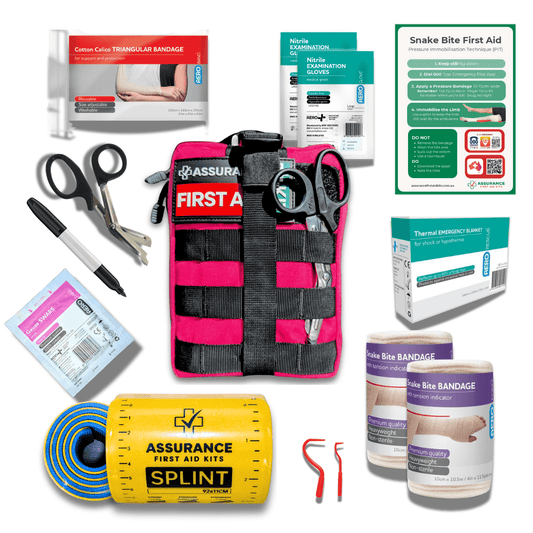
Unlike the five-item Dayspring tin, a modern Assurance snake bite kit is built around the ANZCOR pressure immobilisation protocol — the bandaging technique that actually works. Here's what's available:
| Kit | Best For | Key Contents | Shop |
|---|---|---|---|
| Assurance Snake Bite Kit | Everyday preparedness, regional households | Snake bite bandages with indicators, gloves, instructions | Shop Now |
| Assurance Snake Bite Plus Kit | Families, farms, outdoor workers | Extended bandage supply, additional trauma items | Shop Now |
| Snake Bite Pink Plus Kit | All the above — in a standout hot pink case | Full Plus kit contents in high-visibility pink packaging | Shop Now |
| Snake Bite Max Kit | Remote workplaces, extended expeditions | Maximum bandage supply, cold pack for redback bites, comprehensive trauma support | Shop Now |
If your kit already contains a general first aid component, you may also want to check the Assurance Family First Aid Kit, the Outdoor First Aid Kit, or the IFAK Hike — all of which include snake bite bandaging.
Watch: Inside the 1950s Snakebite Kit
Samantha walks through the original Dayspring Venomous Bite Outfit — item by item — and explains exactly why each piece was wrong. It's a fascinating piece of Australian first aid history and a reminder of how far we've come.
Frequently Asked Questions
Does cut-and-suck actually work for snakebite?
No. Research has conclusively shown that cutting and sucking a snake bite site is ineffective and potentially dangerous. Australian elapid venoms travel through the lymphatic system, not surface blood vessels. Suction retrieves negligible amounts of venom, while cutting the skin introduces infection risk. The current ANZCOR-recommended treatment is pressure immobilisation bandaging (PIB), not incision or suction.
Should I apply a tourniquet to a snake bite in Australia?
No. Tourniquets are contraindicated for Australian elapid snake bites. Because Australian snake venom travels via the lymphatic system, a tourniquet does not prevent venom spread. Worse, it causes ischaemia (loss of blood flow to the limb), concentrates any venom locally, and can result in serious tissue damage. Apply pressure immobilisation bandaging instead and call 000.
Why shouldn't I wash or clean a snake bite wound?
Residual venom on the skin surface is used by hospital staff to identify the snake species via a venom detection kit. This allows them to administer the correct antivenom. Washing or wiping the bite site removes this information and can delay appropriate treatment. Leave the site undisturbed and bandage firmly over it.
Who invented pressure immobilisation bandaging?
Dr Struan Sutherland, a toxicologist at the Commonwealth Serum Laboratories in Melbourne, developed the pressure immobilisation technique in 1979. His research showed that Australian elapid venoms travel via the lymphatic system and that firm pressure over the bite site, combined with immobilisation of the limb, significantly slows this process. His work transformed snakebite first aid in Australia and internationally.
Are old-style snakebite kits still sold in Australia?
The cut-and-suck style kits are no longer sold as snakebite first aid products in Australia. Current Australian standards, guided by ANZCOR, specify pressure immobilisation bandaging as the correct treatment. Some novelty or collector items may still circulate, but they should not be used for first aid purposes. If you're unsure whether your current kit is up to date, use our kit finder to check what's right for your situation.
Is Your Snake Bite Kit Ready?
The science has moved on from the 1950s. Make sure your kit has too. Whether you're on a farm in western NSW, heading out on a trail, or just want to be ready at home — an ANZCOR-aligned kit from Assurance means you're prepared with the approach that actually works.
Samantha suggests one of the following options:
Related Reading
- How to Apply a Snake Bite Bandage Correctly in Australia (Step-by-Step)
- What Does Snake Venom Do in the Body? Australian First Aid Guide
- The Ultimate Snake Bite First Aid Kit: Be Prepared for Australian Snake Season
- Do I Really Need a Snake Bite Kit in Australia?
References
- Australian Resuscitation Council — Envenomation — Snakebite — resus.org.au
- Australian Venom Research Unit, University of Melbourne — Snake Bite First Aid — biomedicalsciences.unimelb.edu.au/avru
- Better Health Channel, Victorian Government — Snake Bite — betterhealth.vic.gov.au
- NSW Health — Snake Bite: First Aid and Prevention — health.nsw.gov.au
- Australian Department of Health — Venomous Bites and Stings — health.gov.au
- ABC Health & Wellbeing — Snake Bites: What You Need to Know — abc.net.au/health